

By Polco on April 22, 2026

The Question Every Applicant Eventually Asks
"Where does it say that?"
It's one of the most common moments in any permitting conversation. An applicant gets a rejection notice citing a requirement they swear wasn't in the instructions. A staff member points to page 47 of the zoning code. The applicant didn't know page 47 existed. Nobody told them to look there.
This isn't a story about bad applicants or unhelpful staff. It's a story about the gap between where the rules live and where the people trying to follow them are standing.
That gap is where Clara was designed to operate. And what makes Clara genuinely effective, rather than just another chatbot bolted onto a government website, is the sophistication of how it finds, interprets, and communicates what your jurisdiction actually requires.
Why Generic AI Falls Short for Government
Before getting into how Clara works, it's worth being honest about what it isn't.
Clara is not a general-purpose AI assistant that has been handed a copy of your municipal code and told to figure it out. That approach, common in first-generation government chatbots, produces answers that sound authoritative but frequently aren't. A general AI model will fill in gaps with plausible-sounding information drawn from other jurisdictions, outdated versions of codes, or simply its best guess. In permitting, a plausible-sounding wrong answer is often worse than no answer at all.
Clara is built on a fundamentally different architecture, one that combines three distinct capabilities working together: a structured knowledge base, retrieval-augmented generation, and live regulatory lookup. Each one solves a different part of the problem.
The Knowledge Base: Teaching Clara Your Rules
The foundation of Clara's accuracy is a knowledge base built specifically for your jurisdiction.
Think of this as Clara's training curriculum. Before Clara answers a single question about your permitting process, it is given the materials it needs to do the job correctly, your application requirements, your submission checklists, your fee schedules, your review workflows, your department-specific procedures. This content is organized, structured, and loaded into Clara's knowledge base in a format optimized for retrieval.
The critical distinction here is that Clara doesn't memorize this information the way a human staff member might. It indexes it. Every piece of content becomes a searchable, retrievable reference point that Clara can pull from the moment it becomes relevant to a conversation.
The practical result: when a homeowner asks what they need to submit for a residential deck addition in your city, Clara isn't guessing. It is retrieving the specific answer from your specific documentation. Not a neighboring county's documentation. Not a version from three years ago. Yours.
This knowledge base can also be built from the kinds of content that governments already have, PDFs, policy documents, procedural guides, FAQ pages, even past correspondence that captures common applicant questions and how they were resolved. If it exists in your organization, it can likely be used to make Clara smarter.
RAG: The Technology That Makes the Answers Trustworthy
Retrieval-Augmented Generation, RAG, is the architectural approach that connects Clara's knowledge base to its conversational ability. Understanding it at a basic level helps explain why Clara's answers are more reliable than those from conventional AI tools.
Here is the core idea. When an applicant asks Clara a question, Clara doesn't just generate a response from its general training. It first retrieves the most relevant content from the knowledge base, the actual documentation, the actual requirements, the actual procedures, and then uses that retrieved content as the basis for its answer.
This matters enormously in a government context. It means Clara's responses are grounded in verified source material rather than constructed from probabilistic inference. It means the answer can be traced back to a real document. And it means that when Clara tells an applicant they need a notarized owner authorization form, there is a specific piece of source content behind that statement, not a confident approximation.
For governments concerned about accuracy and liability, this is not a small thing. The difference between an AI that sounds right and an AI that is right, and can show its work, is the difference between a useful tool and a risk.
Live Regulation Lookup: Keeping Clara Current
Knowledge bases are powerful, but they have one inherent limitation: they reflect what was true when they were built. Codes get amended. Fee schedules get updated. New requirements get adopted. A static knowledge base can become outdated, and an outdated knowledge base gives wrong answers.
Clara addresses this with live regulatory lookup, the ability to search official government websites, published code repositories, and authoritative regulatory sources in real time as part of answering a question.
When an applicant asks about a requirement that may have recently changed, Clara doesn't rely solely on its knowledge base. It checks. It pulls current information from the official sources your jurisdiction uses. It cross-references. And it surfaces the most current answer available, noting when information comes from a live source versus the structured knowledge base.
This means Clara can stay accurate even as regulations evolve, without requiring your team to manually update its knowledge base every time something changes. It is a meaningful operational advantage for any jurisdiction where keeping up with code amendments is already a challenge.
Reading What Applicants Actually Submit
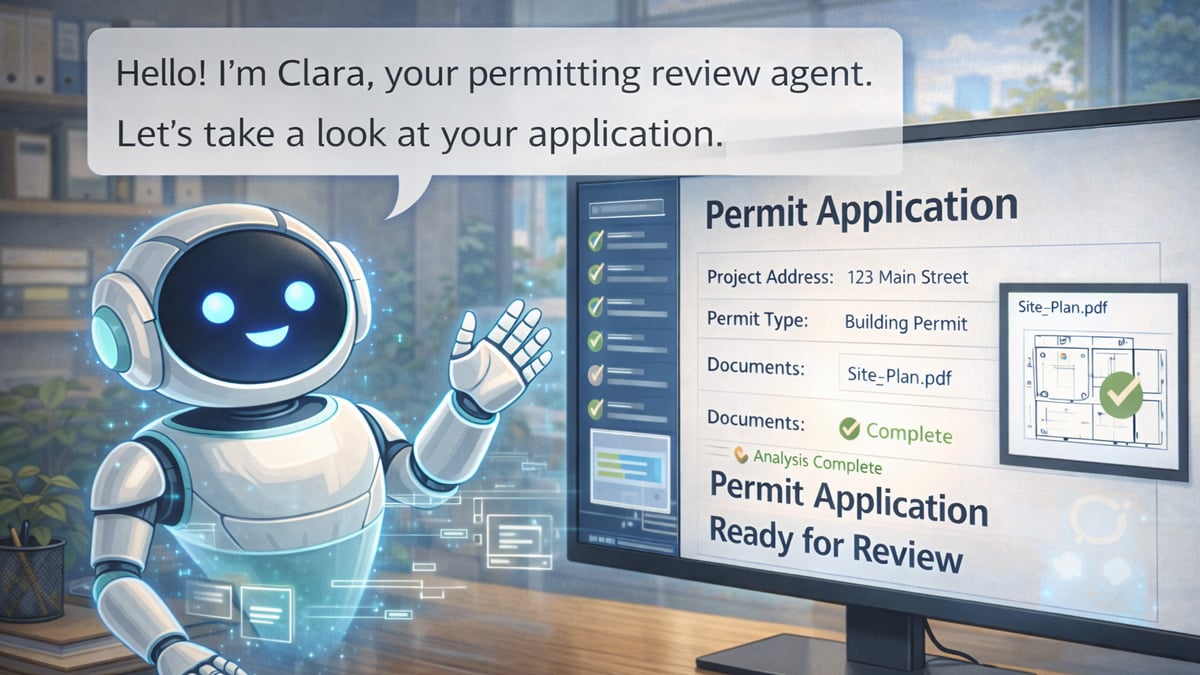
One of Clara's most practically useful capabilities sits at the intersection of all three technologies above, the ability to read and interpret documents that applicants upload as part of their interaction.
This includes typed forms, scanned documents, PDFs, and yes, handwritten drawings and plans.
Permit applications have always included hand-drawn elements. Site sketches. Floor plan modifications. Notes in the margins. These have traditionally required a human to interpret, which means they could only be reviewed during business hours, by a staff member, after the application had already been submitted. If the drawing was missing a dimension or lacked a required notation, that discovery came days or weeks later.
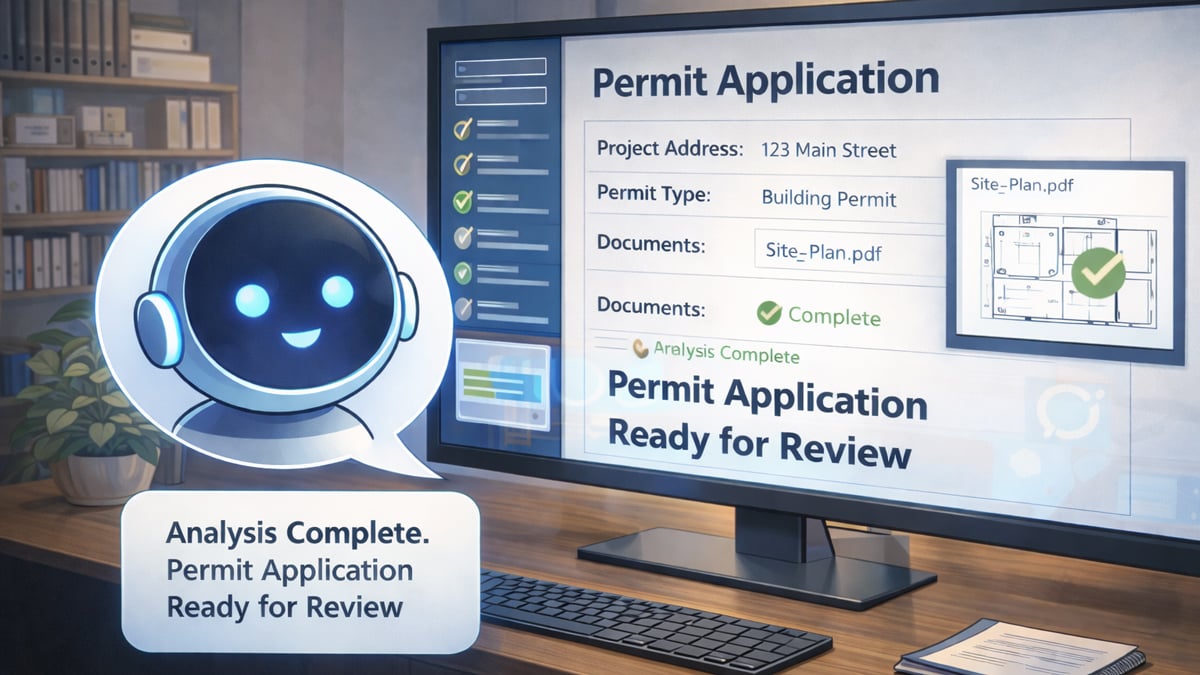
Clara can review uploaded drawings as part of the pre-submission conversation. It can identify missing elements, flag dimensions that aren't included, note required annotations that are absent, and ask the applicant to address them before submitting.
This works best with clear drawings and legible handwriting, and it's worth being direct about that. Clara is not infallible at interpreting every submission, and complex or ambiguous documents may still require human review. But for the majority of standard permit applications, this capability alone eliminates one of the most persistent sources of pre-submission error.
What This Looks Like in Practice
Put it all together and the experience for an applicant changes fundamentally.
They start a conversation with Clara. They describe their project. Clara asks targeted questions, project type, location, scope, and begins drawing on your jurisdiction's knowledge base to outline what they'll need. As the applicant works through the process, Clara retrieves specific requirements from the appropriate documentation. If a requirement touches an area where regulations have recently changed, Clara checks live sources to make sure what it's telling the applicant is current.
When the applicant is ready to submit supporting documents, they upload them directly. Clara reviews them against the requirements it has already outlined. A handwritten site plan goes through the same review process as a typed specification sheet. If something is missing, Clara catches it there, in the conversation, rather than two weeks later in a rejection letter.
By the time an application moves forward, it has been reviewed by an AI that knows your jurisdiction's requirements in detail, has access to current regulatory sources, and has cross-referenced the submission against both. What lands in your queue is ready.
The Confidence That Comes From Verified Answers
There is a specific kind of frustration that comes from receiving confident, wrong information from a government system. It erodes trust, in the system, and sometimes in the government itself.
Clara's architecture is designed to prevent that experience. The combination of a jurisdiction-specific knowledge base, RAG-grounded responses, and live regulatory lookup means that when Clara gives an applicant an answer, that answer is verifiable, traceable, and current. It isn't a guess. It isn't a generalization borrowed from another city's process. It is an answer rooted in your policies, your codes, and your requirements.
That reliability is what allows Clara to act as a genuine front-door guide for your permitting process, not just a FAQ bot that reduces call volume slightly, but a substantive tool that changes what arrives at staff's desks and what applicants experience when they engage with city hall.
Built for Government, Not Retrofitted Into It
The architecture behind Clara, the knowledge base, the RAG retrieval, the live lookup, the document reading capability, wasn't assembled from consumer AI tools and repurposed for government. It was designed from the ground up for a context where accuracy is non-negotiable, regulations are complex, and the consequences of wrong answers fall on real people.
That design orientation is what makes Clara a tool that government staff can trust, that applicants can rely on, and that administrators can configure with confidence. It knows what it knows, it knows where it's getting the information from, and it knows what it doesn't know, which is often the most important thing an AI in a civic context can understand about itself.
Clara is available now as Polco's flagship AI permitting agent. To learn how Clara can be configured for your jurisdiction's specific requirements and workflows, click the Request Information button.

Your Rules, Your Agent: How Clara Adapts to the Way Your Team Actually Works
Why Permitting Is Broken and Why AI Is the Fix Government Has Been Waiting For