

By Polco on May 11, 2026

Communities Are Aging. The Smart Ones Are Planning for It Now.
By 2030, every Baby Boomer will be over age 65. That shift is already reshaping local communities across the country.
The question is no longer if your community will need an aging strategy. The question is whether your organization has the data to build one that residents trust, leaders support, and funders will invest in.
That is where the Community Assessment Survey for Older Adults, or CASOA, becomes essential.
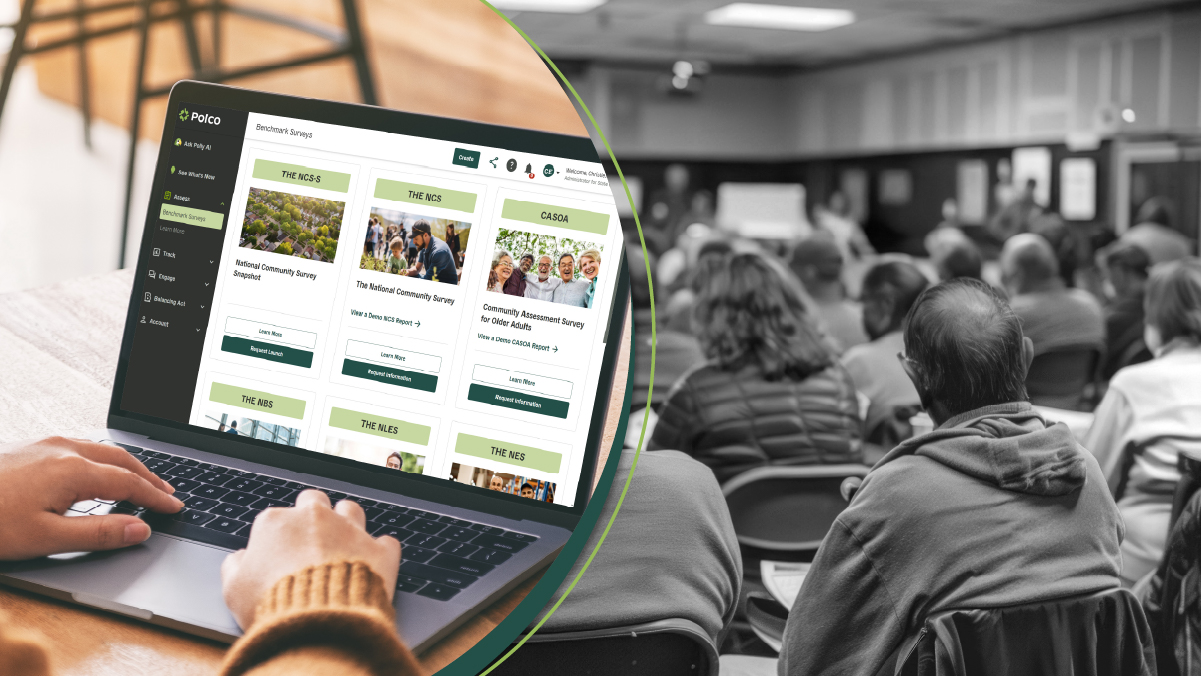
CASOA gives local governments precise, demographic-level insight into how older adults experience housing, transportation, health access, safety, social connection, mobility, and quality of life. Unlike assumptions or anecdotal feedback, CASOA delivers statistically valid benchmark data that helps leaders prioritize investments with confidence.
And in 2026, communities that plan proactively for aging populations will be the ones best positioned to compete for grants, improve livability, and strengthen long-term resilience.
Why “Aging in Place” Is Becoming a Core Government Strategy
Most older adults want to remain in their homes and communities as they age. But many local governments still lack the infrastructure, services, and planning frameworks to support that reality.
Transportation gaps isolate residents. Housing stock becomes inaccessible. Social disconnection increases. Health services become harder to reach. Small barriers compound into major quality-of-life challenges.
The problem is not a lack of caring. It is a lack of measurable, community-specific data. CASOA was designed specifically to solve that challenge.
Polco’s CASOA benchmark survey measures seven dimensions of livability for older adults:
- Community design
- Overall quality of life
- Employment and finances
- Equity and inclusivity
- Health and wellness
- Information and activities
- Productive activities
Those insights allow leaders to move beyond generic “senior initiatives” and toward evidence-based planning.
What CASOA Data Actually Helps You Do
The strongest aging strategies are not built on broad assumptions. They are built on measurable priorities.
CASOA helps communities identify:
- Which neighborhoods face the greatest mobility barriers
- Whether older adults feel socially connected or isolated
- Gaps in transportation access
- Concerns around housing affordability and accessibility
- Differences between demographic groups
- Service awareness gaps
- Safety perceptions
- Opportunities for volunteerism and civic participation
That level of detail matters because aging populations are not monolithic. Needs vary dramatically by income, geography, race, health status, and housing situation.
With benchmark data, local governments can prioritize investments strategically instead of reactively.
Indiana’s Example: Turning Older Adult Feedback Into Long-Term Planning
The State of Indiana has used CASOA multiple times to better understand the evolving needs of older residents. Their longitudinal data gave leaders a clearer picture of what was improving, what was declining, and where additional support was needed.
Indiana residents identified housing, physical health, and access to adult services as top priorities. The data also revealed how pandemic-era isolation affected perceptions of recreation, transportation, and public spaces.
More importantly, the results directly informed statewide planning efforts.
As Erin Wright from Indiana’s Division of Aging explained, repeated CASOA surveying helped leaders maintain “a longitudinal measure of the pulse that is going on around the state with older Hoosiers.”
That is the real value of benchmark data. It does not just help leaders understand today’s conditions. It helps them track change over time and justify future action.
Why CASOA Strengthens Grant Applications
Funding agencies increasingly expect measurable evidence.
Whether applying for federal aging grants, transportation funding, housing initiatives, health programs, or community development support, governments need data that demonstrates both need and strategic alignment.
CASOA helps communities:
- Quantify resident priorities
- Identify underserved populations
- Demonstrate demographic trends
- Validate proposed investments
- Benchmark against peer communities
- Establish baseline metrics for future reporting
That turns aging-related planning from a qualitative discussion into a defensible, evidence-backed strategy.
And that changes conversations with elected officials, boards, and funding partners.
Benchmarking Matters More Than Ever
One of CASOA’s biggest advantages is benchmarking. Communities are not operating in isolation anymore. Leaders increasingly want to know:
- How do we compare to peer communities?
- Where are we outperforming national averages?
- What issues are emerging elsewhere first?
- Which investments are producing measurable improvements?
Benchmark surveys help answer those questions.
Polco’s benchmark framework allows communities to compare results across jurisdictions while still maintaining local specificity. That combination of local insight and national benchmarking creates stronger strategic planning.
It also helps leaders communicate urgency internally. A transportation concern becomes harder to ignore when your community ranks significantly below peer averages for mobility among older adults.
The Communities That Thrive Will Be the Ones That Listen Early
Age-friendly planning is not only about older adults. It is about designing communities that work better for everyone.
Accessible sidewalks benefit parents with strollers. Better transit improves workforce mobility. Stronger social connection reduces isolation across generations. Mixed housing options support economic resilience.
Communities that invest in aging-friendly infrastructure today are building stronger communities for tomorrow. But successful planning starts with listening.
Polco helps governments combine benchmark surveys, resident engagement, and analytics into one connected decision-making ecosystem. From benchmark surveys and public engagement tools to data visualization and AI-powered insights, Polco helps leaders move from assumptions to action.
Because the best community strategies are not built on guesswork. They are built on trusted data, transparent engagement, and a clear understanding of what matters most to residents.
Ready to Build a More Age-Friendly Community?
Community Assessment Survey for Older Adults (CASOA) gives local governments the evidence they need to support aging-in-place strategies that are measurable, fundable, and community-driven.
As older adults become a larger share of every community, the organizations that lead proactively will be the ones best prepared for the future.
The question is not whether your community is aging. It is whether your planning is keeping up.

What Your Community Really Thinks (And Why Most Leaders Are Wrong)

Aging in Place Is a Data Problem Before It Is a Policy Problem