

By Polco on January 9, 2026

Over the past few weeks, we've been sharing stories about the technology crisis facing local governments, the 9 PM permit renewal that requires a printed form, the 60,000 manual public records requests, the knowledge walking out the door with retiring staff.
The response has been overwhelming.
Government leaders from across the country have reached out to say "That's exactly what we're dealing with." Technology directors have forwarded articles to their city councils. Department heads have used them to explain why their teams are so frustrated.
But here's what surprised us most: The comments from a county administrator in rural Montana sound identical to those from a CTO in a major East Coast city. A mid-sized California municipality is facing the exact same challenges as a Texas township.
That pattern, the universal nature of these struggles, is what led us to dig deeper.
The Research Behind the Stories
We spent months analyzing publicly available strategic plans, budget documents, and technology assessments from over 150 cities and counties across the United States. We reviewed thousands of pages from jurisdictions of every size and geography:
- Small townships managing 50,000 residents
- Mid-sized cities with populations in the hundreds of thousands
- Major metropolitan areas serving millions
- Rural counties with limited resources
- Urban counties with extensive infrastructure
We specifically looked for what governments themselves identified as their biggest technology challenges, their stated priorities for modernization, and where they were planning to invest limited resources.
We weren't trying to sell anything or validate a predetermined conclusion. We genuinely wanted to understand: What are the real technology challenges facing local government in 2026?
The Finding That Changed Everything
Here's what we expected to find: Different problems based on size, geography, and budget.
Maybe large cities would struggle with complexity while small towns dealt with limited resources. Maybe coastal jurisdictions would face different challenges than heartland communities. Maybe wealthy suburbs would have solved problems that rural counties still wrestled with.
We were shocked.
Despite vastly different sizes, geographies, budgets, and political landscapes, the problems were identical. Not similar. Not comparable. Consistent across the board.
A county in rural Idaho faces the same public records management challenges as a major urban center. A mid-sized California municipality struggles with the same permitting delays that frustrate developers in Texas. From New Mexico to Maryland, from small townships to large metro areas, the same five themes emerged in document after document.
It's not a regional problem. It's not a budget problem. It's not a political problem.
It's a systemic challenge affecting local government everywhere.
The Five Critical Technology Imperatives
As we reviewed the research, five themes appeared so consistently, across every type of jurisdiction we studied, that they became the foundation of our analysis. We call them the Five Critical Technology Imperatives because they're not optional anymore. They're requirements for survival.
1. The Integration Crisis: When Systems Don't Talk
The Problem:
Governments are drowning in disconnected software. Permitting uses one system. Finance runs on a decades-old platform. Community development tracks projects in spreadsheets. Public works has its own tool. None of them communicate.
One jurisdiction described their current data state as a "digital trashcan", information goes in, but there's no way to retrieve, analyze, or use it for decision-making.
Staff waste hours daily manually moving data between platforms. Residents get conflicting information depending on which department they contact. Leadership is making multi-million dollar decisions without seeing the complete picture because the pieces exist in silos.
The Impact:
This isn't just inefficiency, it's opportunity cost. When your team spends 20 hours a week reconciling data, that's 20 hours not spent improving service delivery. When residents have to tell their story three times to three different departments, trust erodes with each repetition.
2. The Engagement Gap: When Democracy Works for Nobody's Schedule
The Problem:
Traditional civic engagement systematically excludes the majority of residents. Tuesday at 7 PM town halls only work for older, more affluent residents with flexible schedules and reliable transportation. Working parents, shift workers, and residents without childcare are locked out of the conversation.
One city allocated $75,000 specifically to technology for hearing from the "silent majority", residents who absolutely have opinions but can't make Tuesday night meetings.
The Impact:
Governments are making million-dollar decisions based on feedback from dozens of voices while claiming to represent tens of thousands. When the excluded majority feels unheard, engagement drops, trust disappears, and communities become harder to govern.
3. The Transparency Trap: When "Public" Doesn't Mean "Accessible"
The Problem:
Across every jurisdiction we studied, residents are demanding transparency, but most governments are still posting static PDFs and calling it done. Budget documents that require a graduate degree to understand. Project timelines that disappear into bureaucracy. Meeting records that technically exist but are practically impossible to find.
Leaders kept describing the "Black Box" problem: residents submit applications or feedback, and it disappears. No tracking. No updates. No explanation of what happened or why.
The Impact:
When governments can't easily explain where money goes or why projects take time, residents fill the void with speculation. Social media amplifies worst-case assumptions faster than agencies can respond with facts. The trust gap grows wider with every unanswered question.
4. The Data Desert: When Decisions Are Made on Gut Feelings
The Problem:
Government leaders are making multi-million dollar investment decisions based on anecdotal evidence, outdated benchmarks, and institutional intuition rather than hard data.
Jurisdictions can report on "outputs", dollars spent, beds created, permits issued, but struggle to measure "outcomes" like long-term impact, program effectiveness, or resident satisfaction. Without outcome data, they can't prove what's actually working.
The Impact:
As funding gets tighter, every dollar needs justification. Programs that might be incredibly effective can't demonstrate it. Ineffective programs continue because nobody has the data to question them. Innovation dies because there's no way to measure whether new approaches actually work.
5. The Manual Process Prison: When It's 2026 and We're Still Using Paper
The Problem:
An astonishing amount of government work still happens on paper, in email chains, and through manual data entry. Staff manually transferring data between systems. Redaction processes that involve reading documents line by line. Financial workflows managed in spreadsheets. Project tracking through phone calls and in-person meetings.
The Impact:
Manual processes aren't just slow, they're fragile. When processes live in email and filing cabinets, they're vulnerable to staff turnover. When the employee who "knows how things work" retires, the knowledge walks out the door. Service quality declines. Processing times increase. New staff struggle to get up to speed.
Why These Five? Why Now?
These aren't random challenges, they're interconnected pieces of the same fundamental problem: infrastructure designed for the 20th century trying to serve residents with 21st century expectations.
And three forces are making the gap impossible to ignore:
The fiscal crisis: ARPA funding is expiring. The safety net that allowed many jurisdictions to defer hard decisions is gone. Every dollar now needs data-driven justification.
The workforce crisis: Baby Boomers are retiring in unprecedented numbers, taking decades of institutional knowledge with them. Governments can't recruit the next generation if the technology looks like it's from 2005.
The trust crisis: When residents can interact seamlessly with Amazon, their bank, and their doctor's office but struggle with basic government services, they start questioning whether government can do anything effectively.
Introducing: The Connected Community
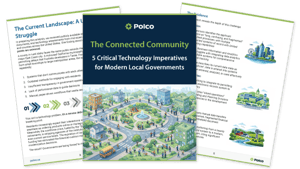 Today, we're releasing the complete research in a comprehensive white paper: The Connected Community: 5 Critical Technology Imperatives for Modern Local Governments.
This isn't a vendor pitch or theoretical framework. It's evidence-based guidance from analyzing what's actually happening in 150+ jurisdictions, what's broken, what's working, and how successful communities are navigating the transformation.
The white paper includes the detailed research, specific examples we couldn't fit into our blog series, and practical guidance for building your modernization strategy.
Download the full white paper →
Join Us for the Deep Dive: Free Webinar January 14, 2026
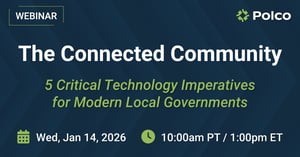 Reading about transformation is one thing. Understanding how to actually do it is another.
On January 14, 2026, we're hosting a free webinar where we'll walk through the complete blueprint for modernization, with real examples, practical roadmaps, ROI data, and plenty of time for your questions.
This isn't about selling you software. It's about sharing what we've learned from 150+ jurisdictions and showing you the playbook that's working.
Who Should Attend:
- City Managers and County Administrators looking to build modernization strategies
- IT Directors and CTOs responsible for technology transformation
- Department heads frustrated by disconnected systems and manual processes
- Council members and commissioners who need to understand what modernization really means
- Anyone who knows their jurisdiction needs to change but isn't sure where to start
Register for the free webinar →
The Choice Ahead
The research is unambiguous: governments that fail to modernize their technology infrastructure will struggle to recruit the next generation of public servants, meet resident expectations, and demonstrate value for tax dollars.
But the research is equally clear about the opportunity: jurisdictions that embrace integrated systems, multi-modal engagement, radical transparency, data-driven decision-making, and workflow automation are already seeing results.
The question isn't whether your jurisdiction will modernize. The question is whether you'll lead the transformation or be forced to catch up.
We analyzed 150 cities and counties to understand what's really happening in local government technology. Now we're sharing everything we learned, the challenges, the solutions, and the roadmap forward.
The white paper is ready. The webinar is scheduled. The path is clear.
The only question left: Are you ready to start?
Download the White Paper:
The Connected Community: 5 Critical Technology Imperatives for Modern Local Governments
Get your copy here →
Register for the Webinar:
January 14, 2026 - The Connected Community: Blueprint for Modernization
Save your spot here →
At Polco, we're not just writing about government transformation, we're building it. Our AI-powered tools help local governments work smarter: permitting agents that understand complex regulations, institutional intelligence models that preserve decades of knowledge, and engagement platforms that reach every resident. Want to see how it works in your community? Let's talk.

AI Is Here. Are City Leaders Ready?

Meet Grace: Your AI-Powered Grant Writing Assistant is Here to Save Time and Sanity