
By Polco on April 28, 2026
The Call That Comes Every Monday Morning
It starts around 8:03 AM. The phones light up before the coffee is finished brewing. Someone wants to know when their trash gets picked up after the holiday. Someone else needs to know if their address falls inside the flood zone. A resident wants to understand why their property tax assessment changed. A developer is trying to figure out which department handles right-of-way encroachment permits.
None of these are unreasonable questions. Every single one of them has an answer that exists somewhere in your organization. And every single one of them will be asked again tomorrow, and the day after that, by different people who have no idea the person before them just called about the exact same thing.
This is the hidden workload of local government, not the complex, high-stakes decisions that require professional expertise and judgment, but the enormous, relentless volume of routine questions that arrive through every channel, at every hour, and land squarely on the shoulders of staff who have other work to do.
There is a better way to handle it. And it doesn't require hiring more people.
What Residents Actually Need When They Contact Government
Before talking about solutions, it's worth being honest about what most resident inquiries actually are. The majority of contacts to a local government, whether by phone, email, website chat, or walk-in, fall into a relatively small set of categories. Service schedules and deadlines. Fee information. Application status. Where to go, who to call, what form to use. Basic explanations of policies that exist but aren't easy to find. Directions through a process that seems complicated from the outside.
These questions don't require a senior planner. They don't require a department director. They require access to accurate, organized information, and someone, or something, available to surface it quickly.
The challenge is that "someone available to surface it quickly" has historically meant a staff member at a desk during business hours. Which means that for the majority of hours in any given week, the answer to a resident's question is essentially: wait until Monday.
That mismatch, between when residents have questions and when government is available to answer them, is one of the most persistent friction points in civic life. It's also one of the most solvable.
The First Generation of Government Chatbots Didn't Help
It's fair to acknowledge that governments have tried chatbots before. Many jurisdictions deployed them in the early days of AI-assisted customer service, and many residents used them exactly once before deciding they were useless.
The reason is straightforward. First-generation government chatbots were essentially digital FAQ pages with a conversational interface bolted on. They could answer the questions they had been explicitly programmed to answer, in the exact phrasing they had been trained to recognize, and nothing else. Ask anything slightly different, and you get a confused non-answer or a generic redirect to the main website.
Residents learned quickly that these tools couldn't actually help them. Staff learned quickly that they weren't reducing call volume. The technology has gained a reputation it is only now beginning to shake.
What has changed is not just the underlying AI, though that has changed dramatically. What has changed is the approach. The most effective government AI customer service tools today are not programmed responses to anticipated questions. They are intelligent agents trained on real government content, capable of understanding what a resident is actually asking and retrieving a genuine, useful answer from a verified source.
The difference in the resident experience is immediate and obvious. The difference in outcomes for staff is equally significant.
What a Government AI Customer Service Agent Actually Does
A well-built AI customer service agent for local government operates on a simple but powerful principle: it connects residents to the information your organization already has, instantly, at any hour, through whatever channel makes sense for them.
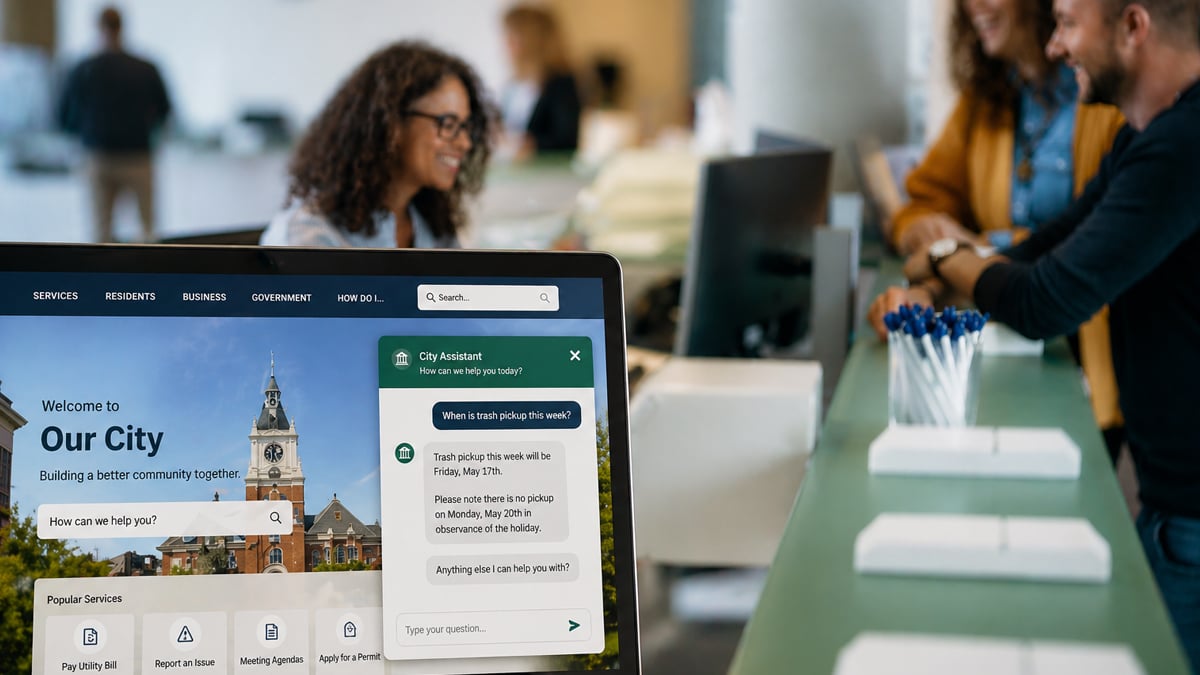
When a resident asks about holiday trash pickup schedules, the agent doesn't search generic databases or make something up. It retrieves the answer from your published schedule. When someone asks whether a specific address requires a stormwater permit, the agent draws on your jurisdiction's actual policies. When a resident wants to understand why their utility bill increased, the agent pulls from the same explanatory content your staff would reference.
The agent understands natural language, meaning residents can ask questions the way they naturally ask them, not in the precise keyword combinations required by a search bar. It handles follow-up questions. It recognizes when a conversation is heading somewhere that requires a human and routes accordingly. It can operate on your public website, your internal staff portal, a dedicated engagement page, or be embedded directly into specific service areas of your digital presence.
And it does all of this at any hour, for as many simultaneous conversations as are happening, without any incremental cost per interaction.
Beyond the FAQ: Handling What Residents Actually Ask
One of the most important capabilities of a modern government AI agent, and one of the clearest differentiators from first-generation chatbots, is the ability to handle complex, multi-layered questions rather than just surface-level lookups.
A resident seeking information about their property tax assessment isn't usually satisfied with a link to the assessor's website. They want to understand how the assessment was calculated, what factors changed, whether they can appeal, how long the appeal process takes, and what documentation they'll need. That's five related questions embedded in one conversation, and a well-built agent can navigate them all, drawing on your actual policies and procedures at each step.
The same applies to budget questions, zoning inquiries, development review processes, public meeting procedures, and dozens of other areas where residents deserve substantive engagement rather than a dead end.
This depth of capability matters not just for resident satisfaction, but for trust. When a government's AI agent gives a resident a thorough, accurate, useful answer at 9 PM on a Sunday, that resident's perception of their local government changes. They experience an institution that is accessible, responsive, and competent. That experience accumulates, and it shapes how communities relate to their governments over time.
The Use Cases Are Broader Than Most Governments Realize
When organizations first think about AI customer service, they typically imagine a chatbot on the city's main homepage answering questions about services. That is a perfectly valid use case, and it alone can meaningfully reduce inbound call and email volume.
But the opportunity is considerably wider than that.
A parks and recreation department can deploy an agent specifically trained on program schedules, registration processes, facility rental information, and park rules, fielding every question that would otherwise go to the front desk or the general inbox.
A public works department can use an agent to handle resident questions about road maintenance timelines, pothole reporting, permit requirements for right-of-way work, and utility service area boundaries.
A planning department can make an agent available during community engagement processes, answering questions about a proposed development, explaining the public comment process, and providing information about upcoming hearings, so that staff time at public meetings is spent on substantive dialogue rather than logistics.
An internal portal can deploy an agent trained on HR policies, employee procedures, department contacts, and operational guidelines, giving staff a place to find answers without hunting through filing systems or waiting for a colleague to respond.
The common thread in all of these is the same: information that exists in your organization, made accessible through a conversational interface, available whenever someone needs it.
What Gets Built Into the Agent Matters
Not all AI customer service agents are created equal, and the difference is largely in how they are built and what they are trained on.
An agent trained on real content from real local governments, structured documentation, actual policies, verified procedures, performs differently from one trained on generic data or assembled without domain expertise. Polco's customer service agents are informed by experience working with more than 500 local governments, meaning the underlying approach to how these agents handle civic topics has been tested, refined, and validated in real government contexts.
The content that powers your agent is equally important. Your published policies, your service documentation, your website content, your frequently asked questions, your procedural guides, all of this becomes the knowledge base that your agent draws from. The more organized and comprehensive that content is, the more useful the agent becomes. And unlike a static FAQ page, the agent doesn't require residents to find the right page, it surfaces the right information in response to what they're actually asking.
Security and privacy are baked into the design. Polco does not sell or share resident data, and the agents are built with government-grade data privacy standards from the ground up, not retrofitted from consumer tools that were designed for different environments.
The Relief Your Staff Has Been Waiting For
There is a version of this story that focuses entirely on the resident experience. But the staff experience is equally important, and equally transformed.
Every routine question that your AI agent answers is a call your staff doesn't have to take. Every after-hours inquiry that gets a real response is an email your team doesn't find waiting for them Monday morning. Every self-service interaction that reaches a satisfying conclusion is a walk-in that doesn't happen.
This is not about reducing headcount. Most governments are not overstaffed, they are understaffed for the demands they face. The value of reducing routine inquiry volume is that the staff you have can focus on the work that actually requires them. The complex constituent interaction that needs empathy and judgment. The application that needs professional review. The policy question that requires someone who understands local context and history.
When an AI agent handles the volume, your people can handle the complexity. That division of labor is not a threat to government employment. It is a recognition that human expertise is valuable, and should be protected for the moments when it genuinely matters.
Starting the Conversation About Starting
For governments that are ready to explore what an AI customer service agent could look like in their organization, the starting point is simpler than most expect.
You don't need a comprehensive content strategy. You don't need a fully organized knowledge base. You don't need to have figured out every use case and configuration before beginning.
You need a clear sense of where residents most often hit friction, where the phones ring the most, where the emails pile up, where the walk-in questions are the most repetitive, and a willingness to start there.
The agent grows from that starting point. It gets smarter as more content is added. It gets more useful as more interactions reveal the questions residents actually ask. It expands into new service areas as your team gains confidence in what it can do.
The governments that have started this journey consistently report the same thing: they wish they had started sooner. Not because the technology was difficult to deploy, but because the relief was immediate, for staff, for residents, and for the relationship between the two.
Polco's AI Customer Service agents are available now, purpose-built for local government and configurable for nearly any public-facing or internal use case.
To learn more or request a demonstration, click the Request Information button


Local Government Employees and Residents Don’t Always See Eye to Eye on Big Strategic Issues

Polco AI: Unlocking Smarter, Data-Driven Communities