

By Polco on April 23, 2026
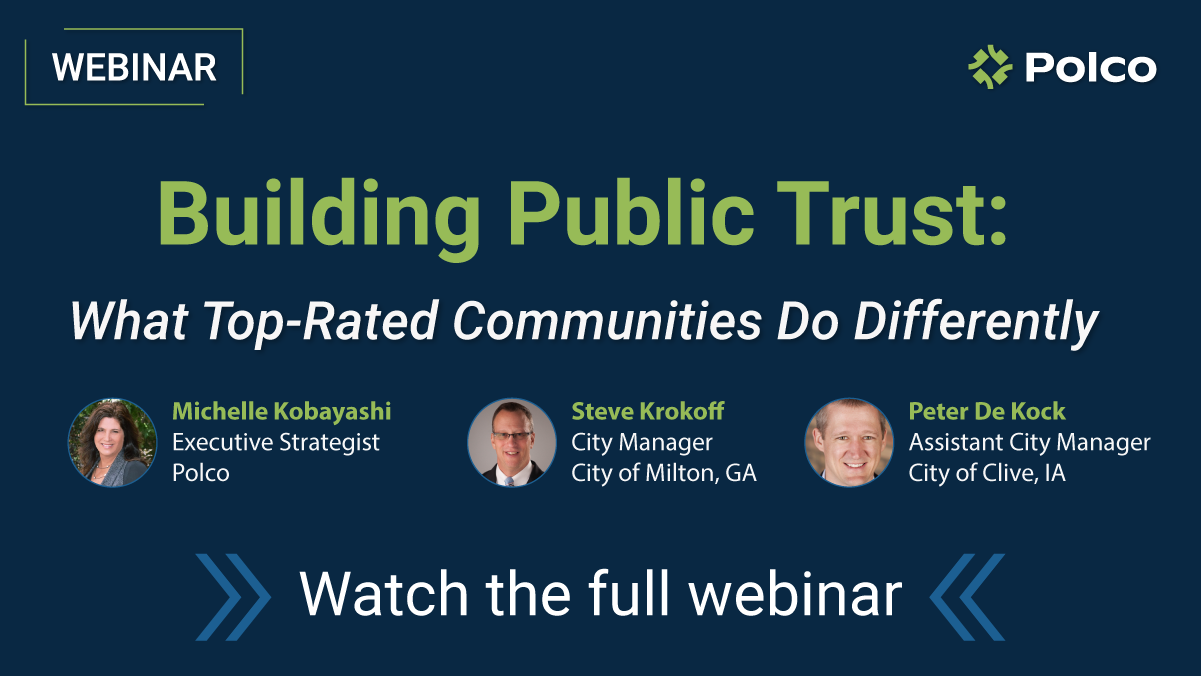
Public trust isn’t just a “nice to have” in local government. It’s the foundation for effective leadership, strong community relationships, and successful policy implementation.
In our recent webinar, “Building Public Trust: What Top-Rated Communities Do Differently,” Polco leaders and award-winning community practitioners explored what truly sets high-trust communities apart and how others can follow their lead.
TL;DR
- Public trust is widely perceived as low, but not immovable
- Top-performing communities take a proactive, data-driven approach to engagement
- Transparency, communication, and follow-through are the biggest trust drivers
- Benchmark data and resident feedback are essential for sustained improvement
The State of Public Trust: A Challenging Starting Point
Early in the webinar, participants were asked a simple question: How much do residents trust local government? The responses were strikingly consistent. Many attendees described trust as “low,” “not great,” or “slowly improving.”
A key theme emerged from the discussion:
Local trust does not exist in a vacuum. Participants noted that perceptions of federal and state government often “trickle down” and shape how residents view local leadership.
This creates a difficult reality for local governments. Even when they perform well, they are often judged through a broader lens of institutional distrust. But that is exactly what makes this work so important.
What Top-Rated Communities Do Differently
The webinar focused on communities recognized through Polco’s benchmarking and awards programs. These communities consistently outperform peers in trust, satisfaction, and engagement.
So what are they doing differently?
1. They Lead with Data, Not Assumptions
Top communities rely on scientifically valid resident feedback to guide decisions.
Polco’s benchmark surveys, like The National Community Survey, are designed to measure community satisfaction, trust, and quality of life across multiple dimensions.
This approach ensures that leaders are not guessing what residents want. They are responding to real, representative insights.
Why it matters:
Data replaces speculation. It gives leaders confidence and gives residents a voice.
2. They Close the Feedback Loop
Collecting input is only the first step. High-trust communities consistently communicate back to residents:
- What they heard
- What they are doing about it
- What progress looks like over time
This aligns with Polco best practices, where sharing results and demonstrating action is critical to building long-term trust.
Why it matters:
Trust grows when people see that their input leads to real outcomes.
3. They Make Engagement Continuous, Not One-Time
Top performers do not treat engagement as a single survey or annual event. They create ongoing opportunities for participation.
Through tools like surveys, polls, and simulations, communities maintain an active dialogue with residents across key issues.
Why it matters:
Trust is built through consistency. Not campaigns.
4. They Invest in Clear, Human Communication
One standout insight from the panel discussion was the importance of storytelling.
Leaders from high-performing communities emphasized that communication is not just about sharing data. It is about making that data meaningful.
This includes:
- Translating complex topics into clear language
- Explaining trade-offs in decisions
- Showing how resident input connects to outcomes
Why it matters:
Transparency is only effective if people can understand it.
5. They Treat Trust as a Strategic Priority
Perhaps the most important takeaway is this: Top communities do not leave trust to chance. They measure it, track it, and actively manage it.
This aligns directly with Polco’s broader mission to help governments make informed, transparent, and community-driven decisions.
Trust becomes part of:
- Strategic planning
- Budgeting decisions
- Performance measurement
Why it matters:
What gets measured gets improved.
Questions We Heard from Attendees
Throughout the webinar, attendees raised thoughtful and practical questions, including:
- How do you rebuild trust when it has already been damaged?
- How do you separate local government perception from national sentiment?
- What engagement methods actually reach underrepresented groups?
These questions reinforce a key point:
There is no single tactic that builds trust. It is the result of sustained, intentional effort across multiple areas.
A New Model for Public Trust
If there is one big idea from this webinar, it is this: Trust is not built through messaging alone. It is built through measurable action, transparent communication, and consistent engagement.
The communities leading the way are not perfect. But they are intentional.
They listen. They act. They communicate. They repeat.
Final Thought
Public trust may feel fragile today. But the data and real-world examples shared in this webinar point to something encouraging: Trust is buildable. And the path forward is clear for communities willing to take it.
Learn more about how Polco can help you improve your public trust!


Community 2.0 - A Local Blueprint to Heal a Divided Nation

What If You Knew The Questions That Could Change Everything for Your Community