
By Polco on July 2, 2026
Wildfires. Floods. Extreme heat. Severe storms. Infrastructure failures. Today's local governments aren't preparing for a single disaster season. They're preparing for an era of constant disruption.
Emergency preparedness has changed dramatically over the past decade. Climate-related hazards are becoming more frequent, more complex, and more costly, while residents expect faster communication, better coordination, and quicker recovery. At the same time, many local governments face staffing shortages, aging infrastructure, and limited budgets.
The good news is that resilience is not built during a disaster. It is built long before one occurs.
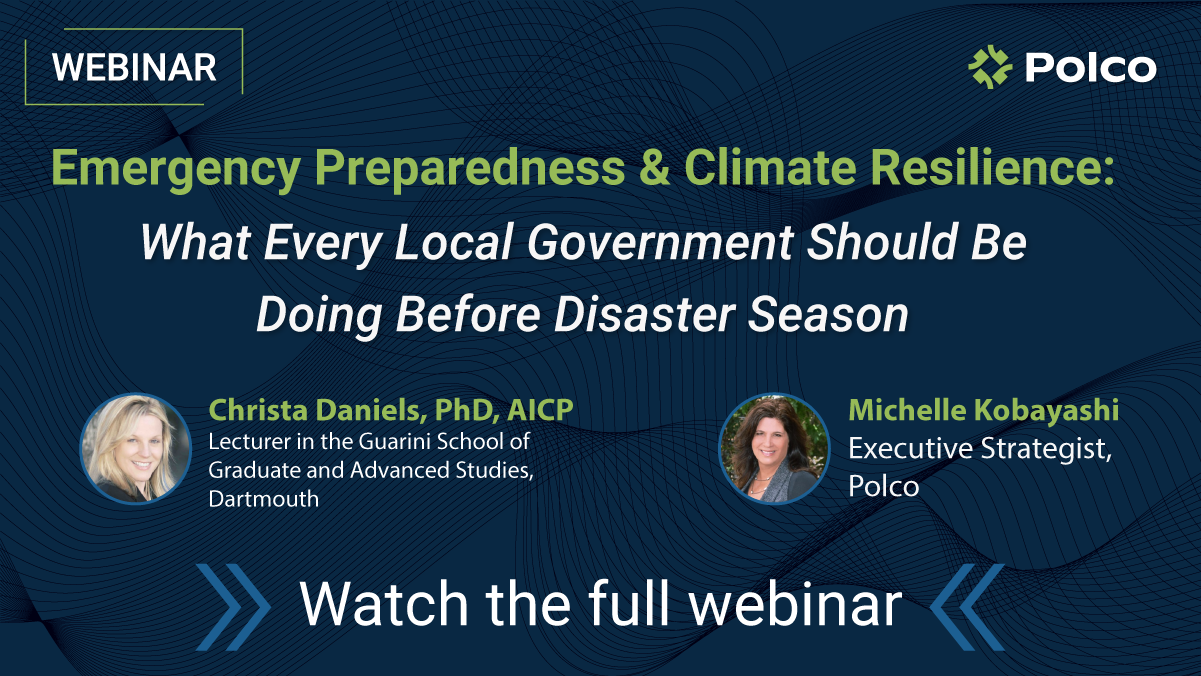
During Polco's recent webinar, Emergency Preparedness and Climate Resilience: What Every Local Government Should Be Doing Before Disaster Season, Executive Strategist Michelle Kobayashi, MSPH, and Dr. Christa Daniels, lecturer at Dartmouth's Guarini School of Graduate and Advanced Studies, shared practical strategies that communities can implement today to become more resilient tomorrow. Their message was clear: the communities that recover best are the ones that prepare together.
Here are five of the biggest takeaways from the discussion.
1. The New Reality Demands a New Approach to Preparedness
For many communities, disaster preparedness can no longer revolve around responding to isolated events.
As Michelle Kobayashi explained, local governments are operating in an environment defined by longer disaster seasons, greater uncertainty, and rising public expectations. Communities face more frequent extreme weather events, aging infrastructure, development in hazard-prone areas, rising recovery costs, and increasing pressure to communicate clearly before, during, and after emergencies.
These challenges require a shift from reactive emergency management to proactive resilience planning.
Instead of asking, "How do we respond when disaster strikes?" city leaders should be asking:
- What risks are growing in our community?
- Which residents are most vulnerable?
- What systems are most likely to fail?
- What investments today will reduce tomorrow's impacts?
Preparedness is no longer simply an emergency management responsibility. It is becoming a whole-of-government strategy.
2. Know What Matters Before You Decide What to Protect
One of the strongest themes throughout the webinar was that resilience begins with understanding what your community depends on most.
Dr. Christa Daniels encouraged communities to begin by identifying their critical assets before investing in projects. Roads, hospitals, utilities, schools, emergency services, supply chains, and communication networks all work together. If one system fails, many others may be affected.
She also emphasized that communities should evaluate vulnerability through three lenses:
- Exposure. What hazards threaten the community?
- Sensitivity. How severely would those hazards affect people and critical systems?
- Adaptive capacity. How well can the community adjust, recover, and continue functioning?
Perhaps most importantly, Daniels reminded attendees that residents themselves are among a community's greatest assets.
"Residents understand a lot of vulnerabilities that never appear on maps. Community knowledge is just as valuable as engineering data when prioritizing resilience investments."
The most effective resilience strategies combine technical analysis with lived experience.
3. Build Community Trust Before You Need It
Emergency communication begins long before an emergency.
Michelle Kobayashi stressed that trust cannot be built in the middle of a crisis. Communities that have invested in relationships before disaster strikes are far more likely to see residents follow evacuation orders, conserve resources, or seek assistance when needed.
Today's emergency communication also needs to be more interactive.
Rather than relying solely on one-way alerts, local governments increasingly benefit from two-way communication that allows residents to report road closures, identify vulnerable neighbors, share local conditions, and contribute real-time information during an event.
The presenters also highlighted the growing importance of:
- Multilingual communication
- Accessible messaging
- Partnerships with trusted community organizations
- AI-assisted customer service during emergencies
- Real-time dashboards showing hazards, shelters, and service availability
When residents trust local government before disaster strikes, they are more likely to act quickly and confidently when it matters most.
4. Think Beyond "Bouncing Back." Plan to Bounce Forward.
Many emergency plans focus on restoring operations after a disaster. Dr. Daniels challenged attendees to think differently.
Traditional engineering resilience emphasizes returning to normal as quickly as possible. Community resilience goes further by asking how communities can adapt and improve because of what they have learned. The goal is not simply to recover. It is to emerge stronger than before.
She described resilience as three stages:
- Persist by maintaining essential services during disruption.
- Adapt by changing how systems operate under new conditions.
- Transform by redesigning systems to better withstand future challenges.
Examples shared during the webinar illustrated how communities are already putting this philosophy into practice:
- Boston is redesigning parks to serve as part of its extreme heat strategy through shade, cooling spaces, drinking fountains, and nearby community centers.
- Portland installed solar-powered microgrids at fire stations to maintain emergency operations during extended power outages.
- Dover, New Hampshire, incorporated rain gardens, permeable pavement, and street trees into downtown redevelopment, reducing flooding while improving public spaces.
These projects solve today's problems while making communities better prepared for tomorrow's.
5. The Strongest Infrastructure Is an Engaged Community
One of the webinar's most compelling messages was that resilience is fundamentally about people. Infrastructure matters. Emergency plans matter. Data matters. But communities recover faster when residents understand risks, participate in planning, and help shape solutions.
Dr. Daniels introduced the concept of community co-design, where residents, planners, emergency managers, and community organizations work together to develop resilience strategies. Residents contribute local knowledge that models and hazard maps often miss, creating solutions that are more equitable, practical, and widely supported.
She also discussed the idea of multi-solving, designing projects that address several community priorities simultaneously.
For example:
- Green infrastructure can reduce flooding while improving water quality and expanding recreational space.
- Resilience hubs can provide cooling during heat waves, emergency power during outages, food distribution after disasters, and gathering places that strengthen social connections year-round.
- Affordable, resilient housing can reduce disaster displacement while strengthening the local workforce and economy.
Rather than funding isolated projects, communities can maximize every investment by creating multiple benefits across resilience, equity, health, and economic development.
Questions Every City Leader Should Be Asking Today
As disaster seasons become longer and more unpredictable, every local government should periodically revisit a few fundamental questions:
- Have we identified our greatest climate and disaster risks?
- Do we understand which residents and neighborhoods are most vulnerable?
- Can residents receive timely, accessible, and trusted emergency information?
- Are community organizations involved in preparedness planning?
- Are we investing in projects that strengthen resilience across multiple community priorities?
Answering these questions before disaster strikes is far easier than trying to answer them during a crisis.
Building Resilience Is a Continuous Process
Emergency preparedness is no longer just about responding to disasters.
It is about understanding community vulnerabilities, strengthening infrastructure, engaging residents, building trust, and making smarter investments that improve quality of life long before an emergency occurs.
As the webinar demonstrated, resilience is not owned by one department or one emergency manager. It is a shared responsibility across local government, community organizations, businesses, and residents.
Communities that prepare together are ultimately the communities that recover together.
Ready to Strengthen Your Community's Resilience?
Polco helps local governments combine resident engagement, community data, advanced analytics, and AI-powered tools to better understand risks, prioritize investments, strengthen public trust, and build more resilient communities.
Request more information today to learn how Polco can help your community prepare for whatever comes next.

The 10 Community Domains You Should Be Tracking Before Your Next Strategic Plan

Local Governments Can Harness AI for Good