Nick Mastronardi, PhD
CEO, Polco | President, National Research Center | Veteran Fellow, Hoover Institution, Stanford University | Honorary Faculty Fellow, University of Wisconsin–Madison
Every organization needs a north star: a measure of success that tells it whether it is getting better at what it exists to do. In the private sector, finding one is relatively easy. In government it is harder, and as budgets tighten, getting it right matters more than ever.
How other sectors set their north star
For-profit companies have a fiduciary responsibility to their shareholders, which in practice means growing total enterprise value and share price. B Corps pursue a balance of that financial return and their stated mission.
Polco is a for-profit company, but we have been clear with all of our investors that pursuing our mission is how we believe we will best meet our fiduciary responsibility. Our shareholders have bought into that, which lets us pursue the mission with their support.
Nonprofits face a different constraint. They can’t raise equity funding, but they also have no fiduciary objective beyond their own sustainability, so they can otherwise pursue their mission exclusively.
What is government’s north star?
Governments exist to deliver public goods and services that would not be delivered otherwise. Kenneth Arrow’s work on the fundamental theorems of welfare economics sets out the conditions under which competitive markets produce efficient outcomes, and by implication where they fall short and it can thus make sense for governments to enter. Paul Samuelson’s theory of public goods explains what their optimal provision looks like.
The key question, then, is how well a government is delivering those public goods and services. The amount it spends doesn’t answer that question: spending is an output, not an outcome. Fiscal health and sustainability probably belong in the equation, but on their own they miss the original intent, which is to assess the quality of public goods and services and the improvements in residents’ quality of life that follow.
What we’re seeing in practice
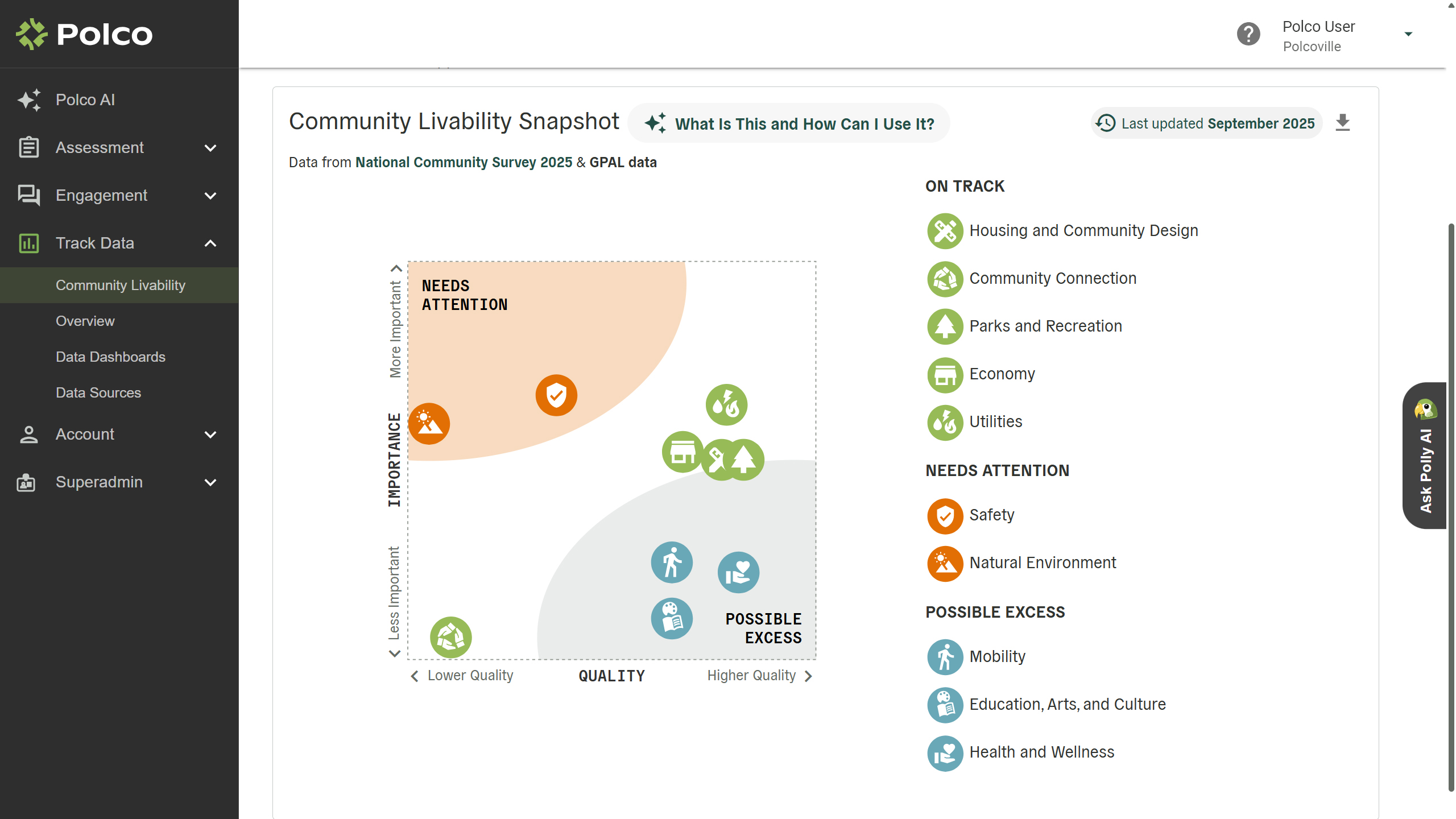
We have this conversation with hundreds of governments every year. Recently we had it with Bloomberg Philanthropies, as we worked with them to assess the effectiveness of their programs on community performance outcomes. Many cities in Bloomberg’s What Works Cities network conduct high-quality resident surveys that measure what matters to residents, how satisfied they are with public goods and services, and how they rate their overall quality of life. So when we evaluated some of these programs, several of the key outcomes we reviewed were residents’ ratings of public services and of their quality of life.
Don’t throw out the compass
Local government budgets are getting tight. That makes it more important to be precise with spending and to understand what is working and what isn’t. If your ship is riding low in the water and you need to reduce weight in your budget, don’t throw out the compass that will help you navigate to your north star.
Some local governments also choose to pursue equity, equality, or redistribution objectives. If yours does, resident sentiment measures are just as crucial to those goals, because they show how different groups of residents experience the same services. Ask us about our new Community Disparity measures.
Measuring what you can’t afford to lose
Whatever your community’s north star turns out to be, constituent sentiment is critical to reaching it. Private sector companies routinely spend a significant share of their annual budgets on business intelligence, and they use CRMs religiously. In government, privacy and attribution concerns mean a CRM isn’t always the right tool (though CRMs have a place, and we can help). Surveys and polls, however, work very well for delivering the organizational performance metrics you can’t afford to lose while navigating shallow budget waters.
For more research from National Research Center and Polco, visit the Polco blog and subscribe to The Civil Review.
References
- Arrow, K. J. (1951). An extension of the basic theorems of classical welfare economics. In J. Neyman (Ed.), Proceedings of the Second Berkeley Symposium on Mathematical Statistics and Probability (pp. 507–532). University of California Press.
- Samuelson, P. A. (1954). The pure theory of public expenditure. The Review of Economics and Statistics, 36(4), 387–389.