
The Data on Data Centers: What Residents Really Think About the Boom Next Door
By Polco on September 8, 2026

A few years ago, most residents would have struggled to define a data center. Today, these buildings are one of the fastest-rising items on local government agendas, and one of the most debated.
There are about 710 data centers operating in the United States and more than 1,000 additional projects planned, according to figures the research firm Cleanview shared with Reuters. These facilities are the physical backbone of the cloud services and artificial intelligence tools people use every day. They also represent one of the largest waves of capital investment in the country right now, and they draw large amounts of electricity, water, and land. When one is proposed near a neighborhood, the promise and the pressure both become local very quickly.Residents hold genuinely mixed views. In a June 2026 Reuters/Ipsos poll of more than 4,500 adults, only one in three said building data centers at a rapid pace is mainly a good thing, and 57% said they would oppose one in their own community. Yet, other surveys find that many of the same residents also recognize real benefits, from jobs and tax revenue to stronger digital infrastructure. The picture is not one-sided, which is exactly what makes it hard to govern.
What data centers can bring
The case for data centers usually starts with investment. Construction spending on these facilities reached an annualized rate of about $59 billion in May 2026, according to Census Bureau data, making them one of the fastest-growing pieces of nonresidential construction. A single large project can generate real local activity. A 2025 study of a proposed data center in Ohio estimated nearly 9,700 construction jobs during the build phase, about $1 billion added to state GDP, and roughly $84 million a year in state and local taxes.
Tax revenue is often the clearest local benefit. In Richland Parish, Louisiana, sales-tax revenue tied to a large Meta campus helped the school board raise full-time teacher bonuses to about $50,900 in 2026, up from about $10,200 the year before, as reported by the Center for Data Innovation. Supporters also point out that data centers can fund new grid and water infrastructure, and that when regulators require them to pay their full cost of service, they can hold down rather than raise costs for other customers.
The benefits are real, but researchers caution they are often smaller and less evenly spread than recruitment pitches suggest. A 2026 Georgia Tech study found that metropolitan areas capture most of the economic gains, while rural counties saw only a small drop in unemployment and little measurable spillover. Data centers also tend to employ relatively few permanent workers once they are built. In short, the upside is genuine, but how much a specific community actually captures depends on the deal and the location.
What they ask of a community
The concerns are just as concrete. In 2023, data centers used roughly 176 terawatt hours of electricity, about 4.4% of the national total, according to Lawrence Berkeley National Laboratory, and utility demand forecasts have climbed sharply as artificial intelligence grows. Cooling the servers takes water. A single large facility can use up to 5 million gallons a day, comparable to a town of 10,000 to 50,000 people, and the World Resources Institute reports that two-thirds of the data centers built or in development since 2022 sit in water-stressed regions. The buildings themselves can span hundreds of acres, sometimes more than a thousand, which raises questions about land use, noise, and farmland.
Here the data gets genuinely contested. One 2026 Rutgers University study of more than 2,000 data centers across 24 states found no clearly detectable link between new data center openings and higher resident electricity bills to date. Other analyses point to grid regions where wholesale power costs rose steeply as large new loads connected. Virginia's legislative audit commission described the state's data center water use as currently sustainable, even as residents near stressed aquifers push for limits. Industry efficiency has improved, with average power usage effectiveness falling from about 2.5 in 2007 to roughly 1.5 today, and analysts note that only about 50-60% of announced capacity tends to come online on schedule, so some forecasts likely overstate the buildout.
The honest summary is that reasonable people read the same figures and reach different conclusions. That is not a reason to tune out the debate. It is a reason to find out what your own community actually weighs, and how.
The decision has moved to the local level
Faster than almost any recent land use issue, data centers have become a matter for city halls and county boards. Many communities are using temporary moratoriums to pause new applications while they write rules, and one national tracker counted roughly four times as many local pauses in 2026 as in the prior year. Others are actively courting the investment with incentives. In Florida, Governor Ron DeSantis signed the Hyperscale Data Center Act in May 2026, which bars utilities from passing data center costs on to residential and small-business ratepayers, adds aquifer protections, and preserves the right of local governments to set stricter standards, approve a project, or turn it down. The common thread is that the choice, and the responsibility, now sit locally.
The loud room is not the whole community
Every one of those decisions tends to start with a packed meeting. A full room is a signal worth listening to. But it is not the same as knowing what the whole community thinks.
The people who show up, whether to support a project or to oppose it, are self-selected. National polling shows the community picture is more layered than any single hearing suggests. The same surveys that reveal real unease also show that many residents see opportunity, and that people weigh different things. Some focus on the environment, some on their monthly bills, some on jobs and the tax base.
For a local leader, that gap is the whole problem. Decide based only on the loudest room and you are still guessing about everyone who stayed home. For a choice this large and this lasting, a guess is not enough.
What to measure instead of guess
The way through is to replace assumptions with evidence: resident input that is structured, representative, and visible to everyone. A few practical moves make the difference, and none of them require taking a side.
Start with a shared baseline
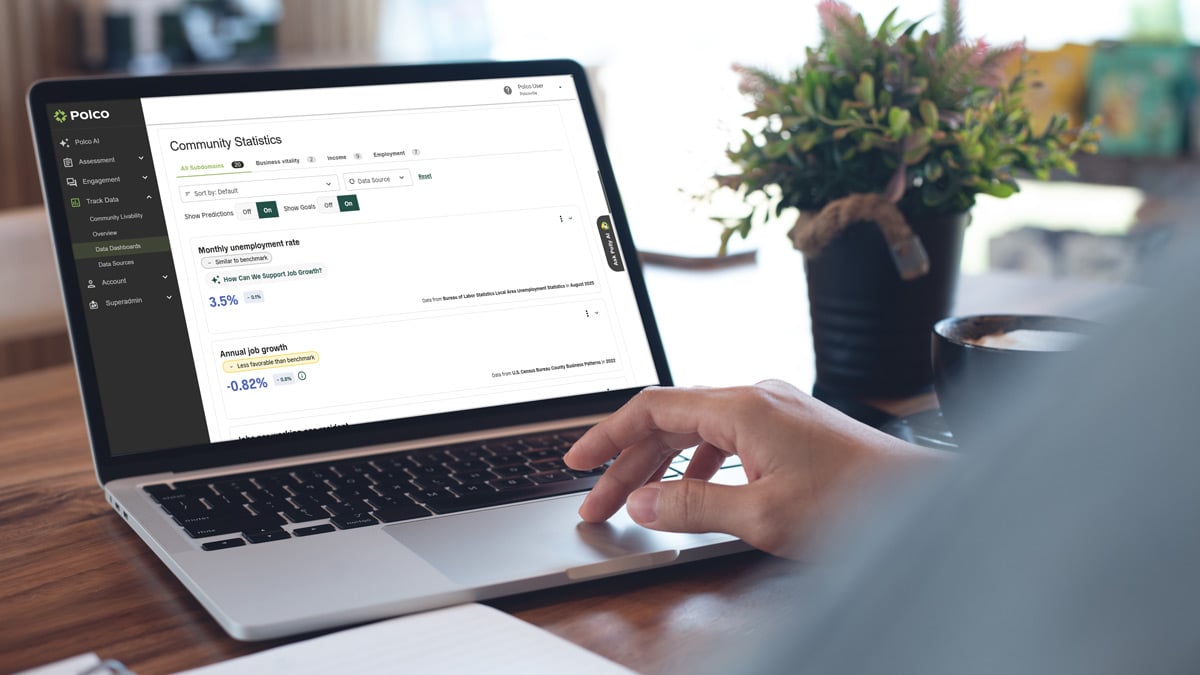
Before the debate turns to opinion, ground it in facts about your own community. Polco's Track Dashboards pull objective local data on utilities, land use, the natural environment, and the local economy from trusted public sources, so the conversation starts from the same numbers rather than competing talking points.
Take a representative read
A scientific Benchmark Survey such as The National Community Survey measures how residents across the whole community feel about the natural environment, utilities, and growth. The National Business Survey adds the perspective of local employers on infrastructure and the business climate. Together they show what the community thinks, not only who attended.
Move quickly when a specific project appears
A short pulse survey or poll can capture a fast pulse check the moment a proposal goes public, which is often when interest runs highest.
Surface the tradeoffs
This is where Prioritize helps. Instead of asking residents only whether they support a project, you can ask them to rank what matters most under real constraints, weighing the benefits they want to capture, such as jobs, tax revenue, or new infrastructure, against the protections they want in place, such as limits on water use, rate safeguards, or buffers from homes. The result is a ranked set of priorities that reflects the tradeoffs a community is actually willing to make.
Bring it together in one place
An Engagement Page can host the background, the poll, the survey, the prioritization exercise, and the results in a single hub, then show residents how their input shaped the outcome. That visible feedback loop is what turns a tense hearing into a process people can trust.
Finding the answer, not steering it
Data centers are not going away, and neither is the debate about them. The demand is real, the investment is real, and so are the questions about power, water, and land. Different communities will weigh those factors differently, and that is exactly as it should be.
Polco's role here is deliberately neutral. The tools above are built to reveal what your residents actually think, across the whole community and not just its loudest corner, so that leaders can make a decision that fits their community and back it with evidence. They are not built to push anyone toward yes or toward no.
The communities that handle this well will be the ones that gather evidence early, listen past the loudest voice in the room, and show residents that their input counted. That is how a flashpoint becomes a decision people can live with, even when they do not all agree.
If you want to see what representative resident input on a growth decision looks like in practice, Request a Demo. You can also Try Polco Free to explore the platform on your own.
Popular posts
Sign-up for Updates
You May Also Like
These Related Stories

From Data to Dialogue: How Resident Voices Strengthen Every Policy Decision
The ROI of Results: Making Data Count in Local Government