

By Polco on March 18, 2026
Engagement fails when residents don’t know where to go
You can have the best survey, the most thoughtful policy proposal, and even a perfectly designed engagement strategy. None of it matters if residents do not know where to find it.
This is the quiet failure behind many public engagement efforts. It is rarely a lack of interest or trust. More often, it is friction.
Too many links. Too many channels. Too many places to check.
When participation feels like work, people opt out.
The solution is simpler than most think. Give residents one place to go.
The problem isn’t apathy. It’s fragmentation.
Most communities do not struggle with creating engagement opportunities. They struggle with organizing them in a way that residents can easily navigate.
Residents are often asked to visit one page for surveys, another for updates, another for budget tools, and yet another for events. Social media adds another layer, often disconnected from official channels.
From the resident’s perspective, the experience feels scattered. There is no clear starting point and no single source of truth. Even highly motivated residents miss opportunities to participate.
When participation drops, it is easy to assume people do not care. In reality, many simply did not see the opportunity.
Enter the resident feed: a single, centralized hub
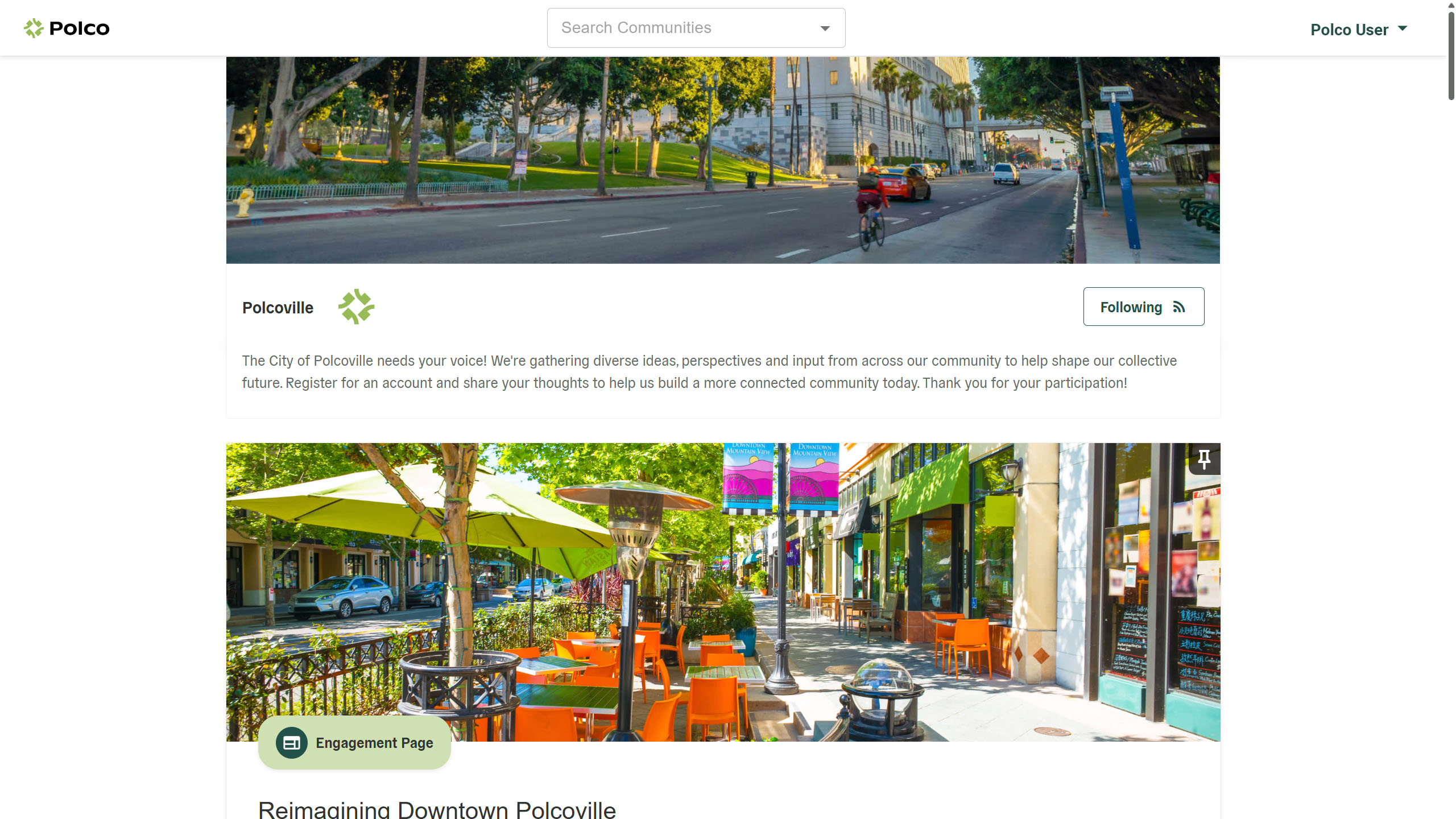
Polco’s resident feed changes this dynamic by bringing everything together in one place.
At its core, the resident feed is a centralized, personalized stream of civic activity. It allows residents to engage with their community through a single, intuitive experience.
In one location, residents can:
- Take surveys and polls
- Read updates and announcements
- Explore data visualizations
- Participate in simulations
- Follow ongoing projects
This eliminates the need to search across multiple platforms. The experience becomes simple, consistent, and accessible.
Why centralization drives participation
Centralization is not just a user experience improvement. It is a fundamental shift in how participation happens.
1. It reduces friction
Every extra step introduces a chance for disengagement. When residents must decide where to go or what to check, participation declines.
The resident feed removes those decisions by delivering content in a real-time, continuously updated stream. Residents can immediately see what is new and relevant without searching.
2. It aligns with modern digital behavior
The feed is designed to be mobile-friendly, easy to scan, and continuously refreshed. These are the same patterns people experience across modern digital platforms.
This alignment matters. Residents are not asked to adapt to government systems. The experience adapts to how residents already consume information.
3. It connects context to action
Effective engagement requires more than collecting feedback. It requires helping residents understand what they are responding to.
Within the feed, content is naturally connected. A project update can appear alongside supporting data and a related survey. This creates a clear narrative that helps residents move from awareness to action.
When people understand the context, participation becomes more meaningful and more likely.
4. It builds ongoing engagement habits
Traditional engagement often operates in campaigns. A survey is launched, promoted, and then fades from attention.
The resident feed supports a different model. Because content is continuously updated, residents have a reason to return regularly. Over time, engagement becomes consistent rather than episodic.
This shift transforms participation from a one-time action into an ongoing relationship.
A better model for modern civic engagement
Today’s residents expect real-time updates, personalized content, and simple ways to participate. Static websites and disconnected tools no longer meet those expectations.
The resident feed delivers a more connected experience that supports transparency, accessibility, and community-driven decision-making. It reflects a broader shift in local government toward continuous, two-way engagement.
What this means for your community
When engagement feels low, the instinct is often to create more content or expand outreach efforts. In many cases, the issue is not quantity. It is clarity.
Providing a single, reliable place for residents to engage can dramatically improve participation. It increases awareness, reduces confusion, and builds trust over time.
The barrier was never interest. It was access.
The takeaway
Engagement does not fail because residents do not care. It fails because they do not know where to go.
The resident feed solves this with a simple principle. Centralize the experience, reduce friction, and make participation easy to return to.
When that happens, engagement stops being something you have to drive. It becomes something that naturally grows.
Polco’s resident feed gives your community one place to stay informed and get involved, helping you increase participation, reduce confusion, and build lasting trust.

How Community Engagement Helps Leaders Make Tough City Budget Decisions
How to Keep Residents Engaged Through Quick Quarterly Surveys