
The State of Us: Assessing Community Strengths, Needs, and Priorities
By Polco on October 5, 2026
Most local governments know they should have a strategic plan. Far fewer have one that actually guides daily decisions.
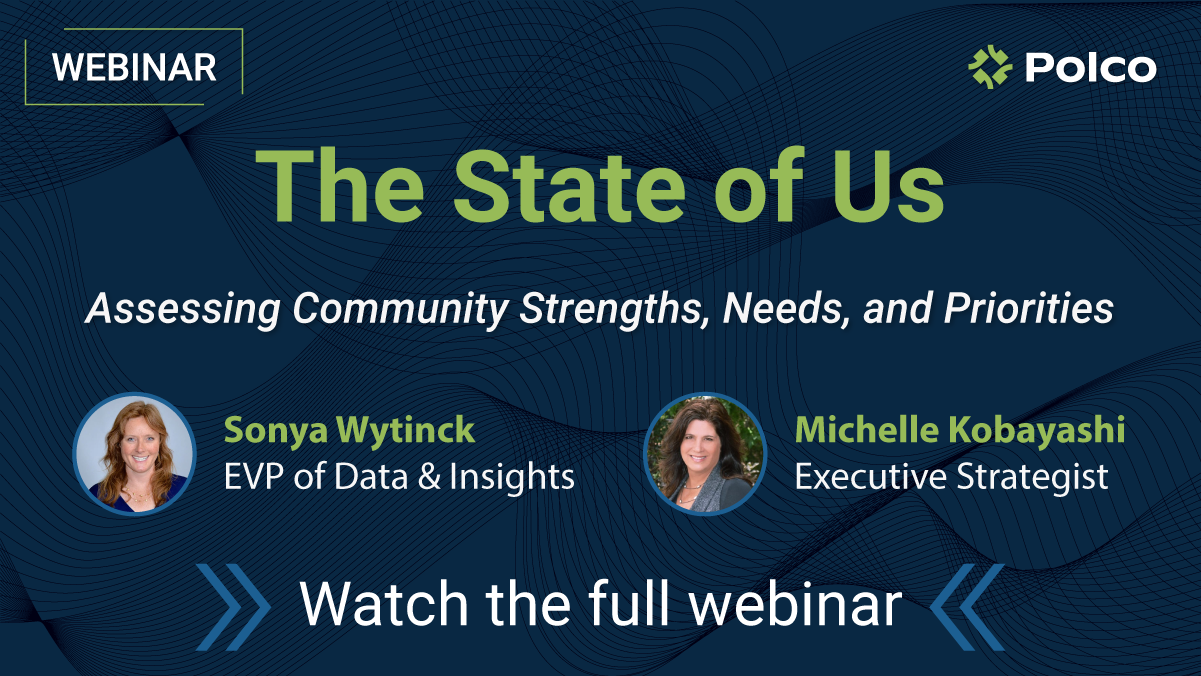
That gap was the focus of Polco's September 2026 webinar, State of Us: Assessing Community Strengths, Needs, and Priorities. Michelle Kobayashi, Executive Strategist at Polco, and Sonya Wytinck, EVP of Data and Insights, shared what separates plans that sit on a shelf from plans that move a community forward.
Watch the full webinar below or read on for a summary of the key takeaways.
Plans Are Common. Follow-Through Is Not.
The session opened with a live poll. About 54% of attendees said their community has a formal strategic plan, and roughly a quarter said they have "something like a plan," such as council priorities or strategic initiatives. Another 4% have a plan in progress, and 18% have none.
Having a plan and using it are two different things. Among attendees with a plan, fewer than half rated it useful or very useful. About 38% called it only slightly useful, and 15% said it was not very useful.
National research tells a similar story. ICMA found that about 5 in 10 communities under 20,000 people had a completed strategic plan, while an earlier ICMA survey found about 8 in 10 jurisdictions of 100,000 or more reported a strategic or long-range plan. Among small communities with a plan, only about a quarter reviewed it annually, and about 40% said a lack of formal reporting hindered or could hinder implementation.
Attendees and the research pointed to the same barriers: limited funding, staff time, and planning expertise, uncertain support from elected officials, and the sense that a budget or council goals are enough. Michelle believes better data and AI are now removing many of these barriers.
Three Ingredients of a Plan That Gets Used
Michelle and Sonya organized the rest of the session around three components:
- Ground the plan in data to understand conditions and trends.
- Listen to stakeholders to understand experiences, needs, and priorities.
- Turn insights into action by setting goals, making choices, and measuring progress.
1. Ground the Plan in Data
Michelle recalled early 1990s planning sessions where one council member wanted a fine arts center, another wanted bike lanes, and a third wanted downtown revitalization. Once community surveys entered the process, far less time went to arguing about what residents needed.
Data shows where a community stands today, how conditions are changing, where needs differ across neighborhoods and groups, and how outcomes compare with peers. Peer comparisons also keep targets realistic. Michelle gave the example of a community aiming for 90% resident satisfaction with planning services, a level she said she has not seen any community reach.
Where plans usually stop
Many plans include goals and strategies but never add performance measures or targets. Without them, no one can tell whether the plan is working. Two Polco clients show what the full path looks like:
- Corona, California pairs its Safe Community goal with a defined set of performance indicators it monitors over time.
- Rock Hill, South Carolina goes a step further with specific targets, such as reducing citywide violent crime by at least 1% annually and responding to Priority One calls faster than a 5.3-minute benchmark average.
Targets can change once a community learns one was set too high or too low. What matters is that staff and elected leaders agree on what success looks like.
Measure what matters
The most useful plans focus on outcomes, not activities. Using the logic model, Michelle explained that residents care less about police response times than about whether they feel safe. A goal like "expand housing programs" is really a strategy. The outcome goal is "residents can find stable homes within their budget."
Where to find the data
Michelle highlighted GPAL (Government Performance Action Lab), which brings 500+ indicators from public data sources into one place. Its domain dashboards let a busy elected official see at a glance which areas, such as safety or community engagement, need attention. Pinellas County, Florida shows how simple a data-driven plan can be: a handful of priority areas, each tied to a few key indicators like housing cost burden and travel time to work.
2. Listen to Stakeholders
Sonya picked up with the second ingredient. Indicators describe conditions, she explained, but stakeholders explain how those conditions affect daily life, what people value, and which tradeoffs they will accept. That input also strengthens the legitimacy of decisions and builds commitment to carrying the plan out.
She also cautioned that resident input should be treated as one input, not a final sign-off. Staff hold important context that residents may not have.
Who to include
A strong plan draws on residents, employees, elected and appointed leaders, businesses, community organizations, and institutional partners such as schools and health care providers. Attendees added church groups, students, nonprofits, and new residents, and stressed multilingual outreach to reach underrepresented groups.
How to reach them
Methods range from stakeholder interviews and town halls to focus groups, Budget Simulations, Prioritize exercises, and scientific surveys. Sonya's advice: choose methods based on whose input the decision on the table actually needs.
Putting input to work
Rock Hill places resident satisfaction trends right alongside its key goals. Corona tracks public confidence and perceptions of fair treatment as part of being a high-performing government, which Sonya noted matters greatly when a community considers a referendum. The National Community Survey (The NCS) gives communities comparable resident ratings across 10 dimensions of livability, with national benchmarks and repeated administrations to track change over time.
Sonya closed her section with Paducah, Kentucky. A new city manager inherited an outdated plan and had little time to build a new one, so the city used The NCS as its foundation. Key staff set goals based on resident priorities in a facilitated workshop. When Paducah surveyed again, ratings had climbed: overall image rose from 54% to 69% and employment opportunities from 19% to 30% between 2013 and 2016.
3. Turn Insights into Action
Even with strong data and stakeholder input, someone still has to set priorities, write the plan, choose strategies, define measures, and track progress. Michelle described long past sessions spent debating single words in goal statements.
This is where she sees the biggest change. Polco's Community Intelligence Report curates more than 60 livability indicators across 10 domains, with time trends and national benchmarks. Michelle recently fed a report into Polco's AI agent, which produced a draft plan with recommended goals, the reasoning behind them, performance measures, and researched strategies. Work that once took her about four months took an hour, plus 10 to 20 hours of refinement. Facilitation, engagement, and collaboration still require people, but the architecture of the plan is far easier to build.
From the Q&A: Plans Should Be Flexible
Attendees asked how to update a plan when historical data matters. Michelle said a community's own trend line is its most important benchmark, and GPAL data goes back 15 years to help fill gaps. Sonya added that when a long-tracked issue stabilizes, communities should clearly explain why it is moving out of focus.
Michelle encouraged plans that evolve each year rather than staying fixed for five or ten. She recommended keeping economy and safety in every plan because residents consistently care about them, while focusing new resources on emerging issues like housing affordability or wildfire mitigation. She also noted that outcome-based plans help break down department silos, because outcomes like safety are shared across many departments.
Start Building a Plan That Gets Used
A strategic plan earns its value when it guides daily work, reflects what residents need, and shows measurable progress. With today's data and AI tools, that kind of plan is within reach for communities of every size.
Request a Demo to see how Polco helps local governments ground plans in data and resident voice. Or Try Polco Free to start exploring your community's data.
Popular posts
Sign-up for Updates
You May Also Like
These Related Stories
Aging in Place: A Government Guide, Backed by Data
The Ultimate Budget Stack: Let Your Entire Community Help Write the Budget