

By Polco on May 18, 2026
A Different Kind of Budget Meeting
Picture a budget presentation that goes differently than usual.
The finance director walks into the council chamber. The room has the familiar tension, department heads protecting their requests, council members bringing constituent concerns, the public gallery with a mix of advocates and skeptics. The same dynamics that make every budget season feel like a negotiation rather than a decision.
But this presentation is different. When a council member asks why public safety infrastructure was prioritized over parks maintenance, the finance director doesn't reach for a spreadsheet or offer an opinion. She pulls up a chart showing that 71% of residents, when given real budget constraints and forced to make real trade-offs in a community simulation, chose public safety investment over parks spending. When another member questions a reduction in administrative staffing, the screen shows performance benchmarks comparing the city's administrative cost ratios to peer communities of similar size.
Every significant decision in that budget document has a story behind it. A story that starts with the community and ends with the numbers. And the thread connecting all of it, the community data, the resident priorities, the financial framework, the narrative, was woven together by a set of tools working in concert.
That is the budget stack we're building toward. And the pieces are already here.
The Problem With How Budget Data Gets Used Today
Most local governments have more data than they know what to do with during budget season.
Survey results from last year. Performance metrics from Track dashboards. Resident feedback from community meetings. Capital improvement requests from every department. Prior year actuals. State-mandated reporting. Demographic data. Economic indicators.
The data exists. What rarely exists is a coherent process for bringing it all together in a way that actually informs budget decisions rather than sitting in folders that nobody has time to synthesize under deadline pressure.
The result is a budget process that is data-adjacent rather than data-driven. Finance teams reference the data they can find quickly and have time to use. The rest gets noted for future consideration and quietly set aside. The budget that emerges reflects the data that was accessible and the priorities of the people in the room, not necessarily the priorities of the community that will live with the decisions.
This is not a failure of effort. It is a failure of infrastructure. The tools to connect community data to budget decisions haven't existed in an integrated way. Until now they've required either significant manual effort or an expensive consultant engagement to do well.
The budget stack we're describing changes that. Not by replacing the judgment of finance professionals, but by giving them an infrastructure that does the connecting work automatically, so that when budget season arrives, the community's voice is already organized, already verified, and already ready to inform the decisions that need to be made.
Layer One: Letting Residents Make the Hard Choices
Every budget conversation in local government eventually arrives at the same uncomfortable reality: there is never enough money to do everything. Services cost more than most residents realize. The gap between what communities want and what they can afford is real. And when that gap has to be closed, somebody has to make difficult choices about what gets funded and what doesn't.
Traditionally, those choices have been made by elected officials and staff, with public input that is well-intentioned but often uninformed by the actual constraints involved. Residents show up to budget hearings to advocate for their favorite programs without knowing what it would take to pay for them. The feedback is genuine but not always useful, because it doesn't reflect an understanding of the trade-offs.
Polco Budget Simulations change that dynamic entirely.
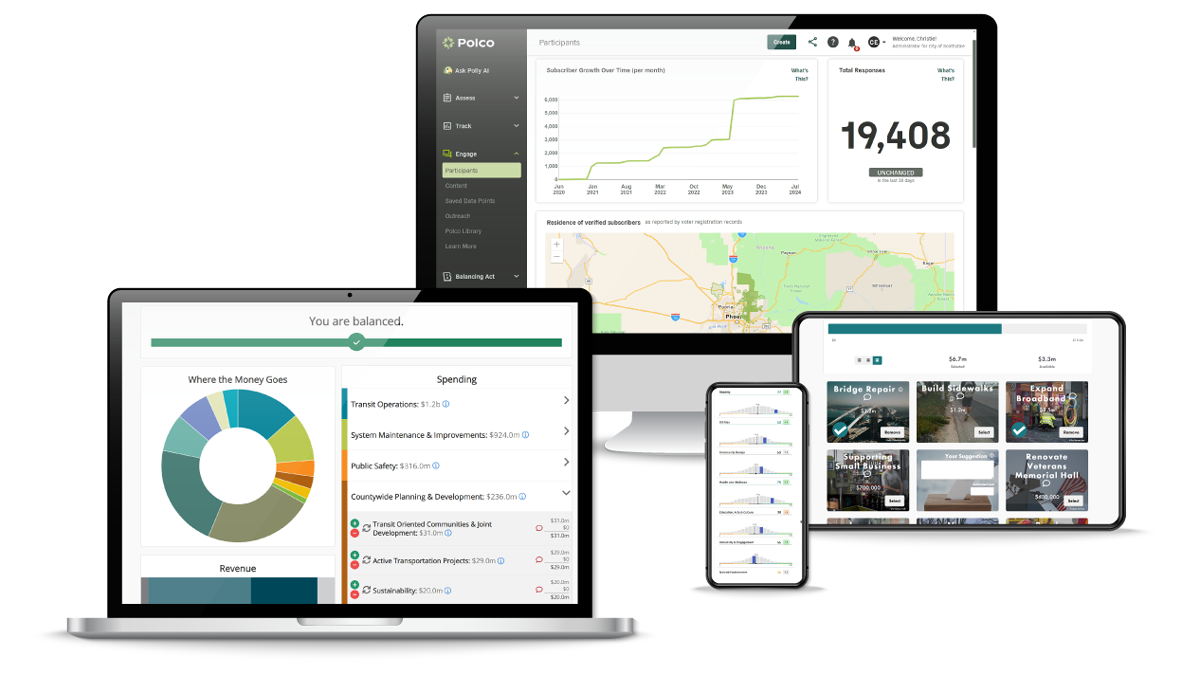
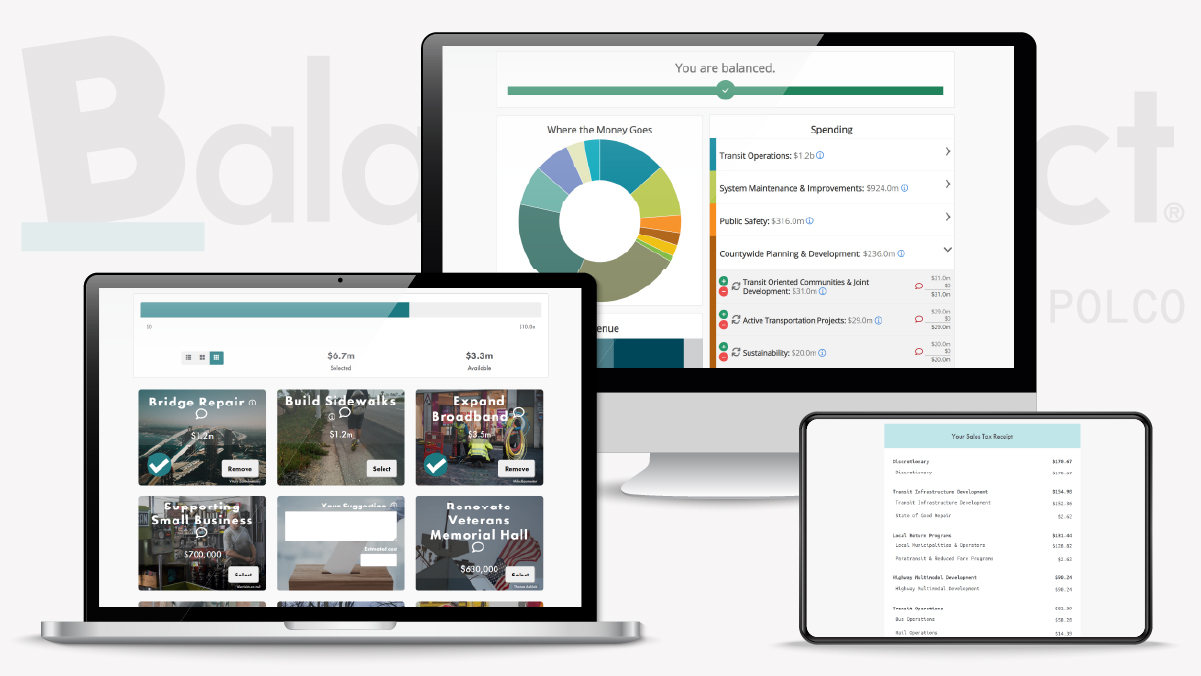
A budget simulation puts residents inside the process. They see the real numbers. They see the real constraints. They have to make choices, increase this service, cut that one, raise this revenue source, reduce that one, and they have to balance the budget before they can submit. The simulation doesn't let them have everything. It forces the same hard choices that finance teams and councils face, with the same actual numbers attached.
What comes back from a well-run budget simulation is not a wish list. It is genuine community priority data, revealed preferences, not stated preferences. When residents who have actually balanced the budget in a simulation choose parks funding over administrative overhead, that choice carries weight that a petition signature or a hearing comment simply doesn't. It is informed. It is constrained by reality. And it is defensible.
That data, the aggregated choices of hundreds or thousands of residents who engaged with the actual trade-offs, becomes the first layer of the budget stack. Community priorities, revealed under real conditions, ready to inform the decisions that come next.
Layer Two: Resident Priorities From the Survey Data You Already Have
Budget simulations reveal what residents choose when forced to prioritize. Survey data reveals what they value, and how satisfied they are with what they're currently getting.
For governments that have conducted the National Community Survey, that data is already sitting in their Track dashboards, organized and benchmarked. Residents have rated the importance of dozens of service areas and their satisfaction with current delivery. The gap between importance and satisfaction, the services that matter most and are performing least well, is exactly the information a budget process needs to direct investment.
When a service area shows high importance and low satisfaction in NCS data, that is a signal. Not a mandate, but a signal, one that a well-structured budget process should be able to engage with directly rather than setting aside because the connection between survey results and budget decisions is too hard to draw manually.
The NCS data also feeds the Community Livability Snapshot, the matrix that plots service quality against resident-rated importance across ten domains of community life. That snapshot, available directly in Polco's platform, is essentially a prioritization map for budget investment. The domains in the lower-right quadrant, high importance, lower quality, are the ones where investment is most clearly aligned with community need. The domains in the upper-left, high performance, lower resident importance, are the ones where reallocation might be defensible.
That map doesn't make budget decisions. But it structures them in a way that is grounded, visible, and explainable, which is more than most budget processes can say.
Layer Three: Prioritization Tools That Surface What Matters Most
Beyond surveys and simulations, Polco's Prioritization tools give governments another mechanism for capturing structured community input on competing needs and initiatives.
Residents can be presented with a set of proposed investments or initiatives and asked to rank them, allocate points across them, or make direct comparisons between pairs of options. The resulting data shows, with more granularity than a simple survey, how the community orders its priorities when choices have to be made.
For capital improvement planning, this kind of prioritization data is particularly valuable. A community that ranks pedestrian infrastructure improvements ahead of downtown beautification is giving a finance team something to work with, a community-validated ordering of priorities that can anchor the capital budget conversation in a way that feels grounded rather than arbitrary.
For operating budget decisions, prioritization tools can help surface which programs and services the community considers essential versus nice-to-have, a distinction that is often the most contested in any budget process and the one most likely to generate council conflict without good data to anchor it.
All of this data, simulation choices, survey priorities, prioritization rankings, accumulates into a picture of what the community actually wants. Not what the loudest voices in the council chamber want. Not what was funded last year. What the community, engaged meaningfully and asked substantive questions, has told the organization it values.
That picture is the foundation that Bobbi builds from.
Layer Four: Bobbi Connects the Community Voice to the Budget Document
This is where the stack becomes something genuinely new.
Bobbi, Polco's AI budget writing agent, currently in development, is being designed to sit at the center of this data ecosystem and do the work that has always been the hardest part of any budget process: connecting the community's voice to the financial document.
When a finance team works with Bobbi, she isn't starting from a blank page. She is starting from everything the community has said, the simulation results, the survey priorities, the NCS satisfaction data, the performance benchmarks from Track, the prioritization inputs. She knows what residents have identified as most important. She knows where performance is lagging. She knows how the community compares to peers on the outcomes that matter.
From that foundation, Bobbi applies the budgeting framework the organization is using, whether that's zero-based, priority-based, outcome-focused, or a hybrid approach, and helps build the budget in a way that is structurally aligned with community data at every significant decision point.
She can help draft the narrative sections that explain why specific investments are being made. She can generate the supporting language that connects a budget line to a community priority. She can help prepare the council presentation that makes the strategy visible and defensible. She can produce the resident-facing explanations that turn a complex financial document into something a community member can actually understand and engage with.
The connection between what the community said and what the budget proposes, the connection that has always existed in theory and been so difficult to demonstrate in practice, becomes explicit, documented, and communicable.
Layer Five: Closing the Loop With Taxpayer Receipts
A budget process that ends with the adopted budget is a budget process that misses its most powerful opportunity.
Taxpayer Receipts, available through Polco's Engagement Tools, let governments show residents exactly where their tax dollars go. Not in the aggregate language of a government financial report, but in the personal, tangible terms of what a specific resident's contribution pays for. Your property taxes this year funded approximately this many hours of police patrol, this many miles of road maintenance, this fraction of the new library renovation.
That specificity changes how residents relate to the budget. Abstract line items become concrete services. The connection between what residents pay and what they receive becomes visible in a way that fosters understanding rather than resentment.
When taxpayer receipts are issued after a budget cycle that was built on community simulation data and resident priorities, when residents can see that the priorities they expressed in a simulation actually shaped where the money went, the civic trust that results is significant. This is not a government that asked for input and ignored it. This is a government that asked for input, used it, and can show the receipts.
That demonstration of responsiveness is one of the most powerful things a local government can offer its community. And it requires exactly the kind of end-to-end data connection that the budget stack makes possible.
What the Whole Stack Looks Like in Practice
Put all five layers together and the budget process looks something like this.
Early in the budget cycle, residents engage with a Polco simulation that presents the actual fiscal choices the community faces. Thousands participate. Their aggregated choices are captured and analyzed. Alongside that, NCS survey data and prioritization tool results provide additional context about what the community values and where satisfaction gaps exist.
Bobbi synthesizes that community input alongside performance data from Track dashboards and GPAL benchmarks. Working with the finance team, she applies the organization's chosen budgeting framework, helping build the budget document from community-validated priorities rather than from last year's allocations. She drafts the narrative sections, prepares supporting language for council presentations, and helps generate resident-facing explanations of complex decisions.
The adopted budget is published with clear connections to the community data that informed it. Taxpayer receipts go out showing residents exactly what their contribution funded. The loop closes, not just for this year, but as the foundation for next year's engagement, which starts with residents who have seen that their input matters.
This is not a theoretical workflow. Every tool in this stack exists today inside the Polco platform. Bobbi is the piece being built now, the intelligence layer that connects everything and does the synthesis work that has always fallen on already-stretched finance teams.
The Budget Officer's Dream Scenario
We have talked to enough finance directors, city managers, and budget analysts to know what they actually want from a budget process.
They want to walk into a council meeting knowing that the recommendations they're presenting are defensible, not just internally logical, but grounded in what their community has actually said. They want the narrative work to not feel like a separate project stacked on top of the financial work. They want to be able to answer the question "why did you prioritize this?" with evidence rather than opinion. And they want residents to understand the budget well enough to trust it, even when the decisions are hard ones.
The budget stack we're describing is built to deliver all of that. Not by removing the judgment of the professionals who do this work, that judgment is irreplaceable and remains at the center of every significant decision. But by giving those professionals a workflow where the community's voice is already organized, the data is already connected, the framework is already applied, and the narrative is already drafted.
What's left is the work that only they can do. And it turns out, when everything else is handled, there's a lot more capacity for that work than budget season usually allows.
Bobbi is in active development as part of Polco's growing AI agent ecosystem. Polco simulations, prioritization tools, taxpayer receipts, and Track dashboards are available now. To learn more about the full Polco budget engagement stack or to be among the first to know when Bobbi is ready, click the Request Information button.


Why Polco's Rethinking Budgeting Tools are Essential for Transparent and Effective Budget Planning
Reimagining Public Budgets: The Beginning of Balancing Act (Now a Polco Tool)