

By Polco on April 13, 2026
A homeowner wants to build an addition. A developer wants to break ground. A small business owner needs a sign approved before opening day. Each of them submits what they think is a complete application, and then they wait.
A few weeks later, a letter arrives, or an email, or a voicemail. Something is missing: a signature, a site plan, or a specification that wasn't listed clearly in the instructions. So they gather the missing piece, resubmit, and wait again.
This cycle: submit, wait, incomplete notice, resubmit, wait, is so common in local government that most people have come to accept it as simply how permitting works. It doesn't have to be.
The Hidden Cost Nobody Is Talking About
When permits are delayed, the conversation usually centers on the applicant's frustration, and that frustration is real. But the cost runs deeper than anyone waiting on a letter.
Developers carry financing costs on idle land. Small business owners delay their openings, sometimes fatally for a business that was already operating on thin margins. Homeowners live in limbo. And in the background, city staff are drowning.
Every incomplete application that reaches a desk is a problem that has to be managed. Staff spend hours tracking down missing information, writing follow-up notices, re-reviewing resubmissions, and fielding phone calls from applicants who just want to know what's happening. It's not the work they were hired to do, it's the work that accumulates because the front door to the process isn't working.
The result is a system that exhausts everyone and serves no one particularly well. Cities don't want slow permits, and neither do residents.
Why the Old Solutions Haven't Fixed It
Governments have tried. Online portals have replaced paper packets. Checklists have gotten longer. Staff have been trained to communicate more clearly. And yet the back-and-forth persists.
The reason is structural. No matter how good a checklist is, applicants will misinterpret requirements. No matter how clear an instruction, someone will have a follow-up question at 9 PM on a Friday. And no matter how responsive staff are, they can only respond during business hours, and only to one person at a time.
The gap between what applicants understand and what the process actually requires is where permits go to die. And until now, there hasn't been a tool designed specifically to close that gap before the application ever reaches a reviewer.
Meet the Real Problem: The Gap Between Submission and Readiness
Here is the core issue in plain terms. Most permit applications don't fail because applicants are careless. They fail because the requirements are genuinely complex, and there is no one available to walk an applicant through them in real time.
Zoning codes are dense. Local regulations vary. Required documentation differs by project type. The language used in official instructions often assumes a baseline of knowledge that most residents and small developers simply don't have. What looks complete to an applicant is missing details that any experienced plans examiner would spot immediately.
The solution is not more paperwork. It's not a longer checklist. The solution is having someone, or something, available to guide every applicant through the process interactively, catch every gap before submission, and only send an application forward when it's genuinely ready for staff review.
This Is Exactly What Clara Was Built to Do
Clara is Polco's AI Permitting Agent, and it is purpose-built for this problem.
Available 24 hours a day, seven days a week, Clara acts as an always-on guide for anyone navigating the permit process. A homeowner starting an addition can ask Clara exactly what they need to submit. A contractor with a question about local setback requirements can get an answer at midnight. A developer confused about which form applies to their project type can get clarity in minutes, not weeks.
And here's what makes Clara different from a searchable FAQ or a static checklist: Clara doesn't just provide information. It engages. It asks follow-up questions. It checks completeness. It flags missing pieces. It works with the applicant until everything is in order, and only then does it pass the application to staff for review.
No more incomplete submissions. No more back-and-forth correspondence. No more weeks lost waiting for a letter to arrive.
How Clara Actually Knows What Your Jurisdiction Requires
This is where the technology becomes genuinely impressive, and where governments sometimes have questions.
Clara is trained using a combination of three powerful capabilities.
-
First, a knowledge base built from your jurisdiction's own requirements, workflows, and documentation, using a technique called Retrieval-Augmented Generation (RAG) that lets Clara pull precise, verified answers from your actual policies rather than making them up.
-
Second, live web search allows Clara to reference official regulations and code updates in real time, so the guidance it provides stays current.
-
Third, a growing library of skills that extend what Clara can do, including the ability to read and interpret uploaded documents, drawings, and even handwritten plans and sketches.
That last capability is worth pausing on. Permit applications often include hand-drawn site plans, sketches, and written notes. Clara can read them. It isn't perfect, handwriting quality matters, but for most standard submissions, it can interpret what's been submitted and identify what's still needed. That alone eliminates one of the most common sources of delay.
The Process That Changes Everything
Imagine what the permitting experience looks like when Clara is part of it.
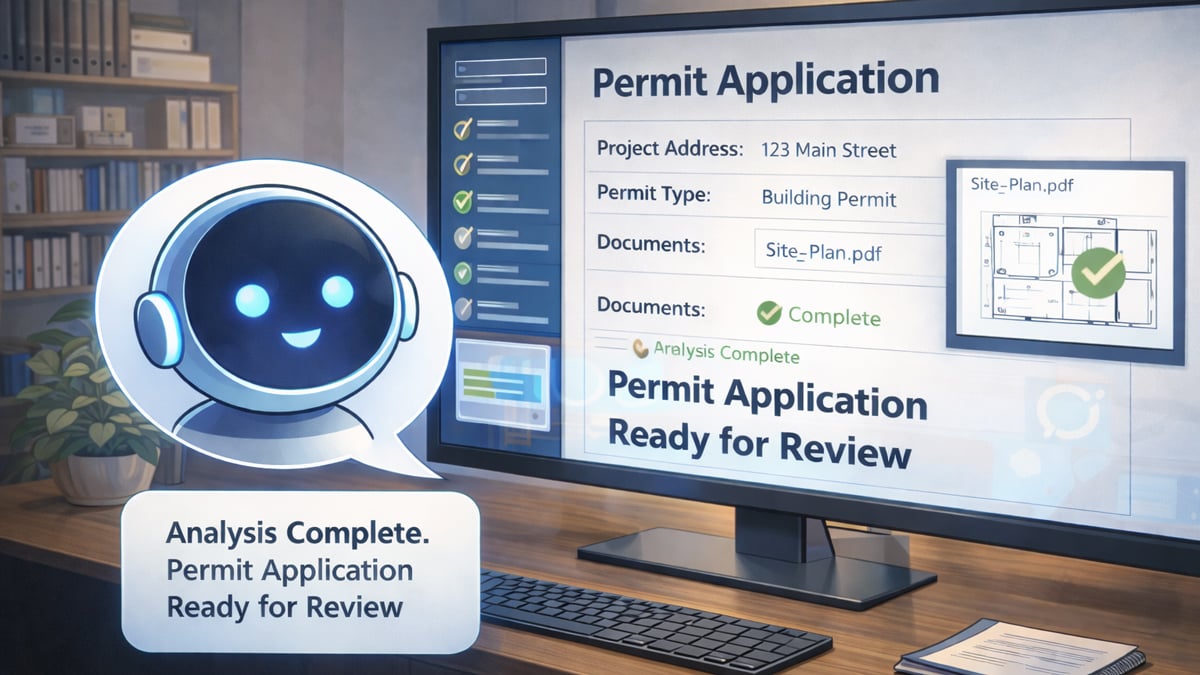
An applicant starts a conversation with Clara from your city's website. They describe their project. Clara asks clarifying questions, project type, location, scope, and then begins walking them through exactly what's required. It references your jurisdiction's specific requirements. It flags gaps. If the applicant uploads a site plan, Clara reviews it and notes what's missing.
This continues, as many times as the applicant needs, at any hour, until the application is complete. Only then is it submitted to staff. What lands in the review queue isn't a problem to be managed. It's a ready file.
Staff spend their time on what they're actually trained to do: technical review, professional judgment, decision-making. Not chasing signatures and answering the same questions for the hundredth time.
Your Process, Your Rules
One question governments often ask: how much control do we have over what Clara does?
The answer is complete control. Clara is configurable to match your jurisdiction's specific workflow. You decide what the agent handles, where it draws the line, and at what point human review begins. Want Clara to handle intake and completeness checks, but have a staff member review before anything is formally logged? Done. Want Clara to field all routine questions but escalate anything involving variance requests? Also done.
The point is not to automate for automation's sake. It's to put the right tasks in front of the right resources, and to make sure that when something reaches a person, it's actually ready for them.
Clara can also be configured for internal use, helping staff quickly look up code requirements, check regulations, or answer applicant questions more efficiently. It's a tool that bends to the shape of your team's needs, not the other way around.
The Problem Was Never the People. It Was the Process.
City planners and building department staff are not the reason permitting is slow. They are often doing extraordinary work under genuinely difficult conditions, managing high volumes, complex regulations, and public pressure with limited resources.
The problem is a process that was designed before the tools existed to do it better. A process that forces skilled professionals to spend their days chasing incomplete paperwork and answering repetitive questions, rather than doing the complex, consequential work they are actually equipped to do.
Clara doesn't replace that work. It clears the path to it.
The Wait Is Over, For Applicants and Governments Alike
The frustration that residents and developers feel waiting on permits is real. But so is the frustration of the staff member who opens their inbox every morning to find a dozen calls about applications that were submitted weeks ago and still aren't complete.
Clara addresses both simultaneously. Residents get a guide that is available whenever they need it, patient enough to walk through every question, and knowledgeable enough to get them to the finish line. Staff get a queue full of applications that are actually ready to review.
That's not a small improvement. That's a structural fix to a structural problem, and it's available right now.
Clara is Polco's AI Permitting Agent, available today as a flagship service for local governments ready to transform their permitting process.


Why Governments Need AI Chatbots: Efficiency, Trust, and Smarter Public Engagement

Why Polco's Rethinking Budgeting Tools are Essential for Transparent and Effective Budget Planning