By Polco on July 24, 2026
Learn how to find your true peers and use their data to set realistic performance targets.
Every performance report seems to reach for the same yardstick. How does our community compare to the national average? It is a comfortable question because it feels neutral. It is also the wrong one.
A national average blends thousands of communities that share almost nothing with yours, then hands you a single number that describes none of them. Set your targets against that number and you will either panic over gaps that do not matter or celebrate results that would look ordinary next to the places you actually resemble. The better approach is to find your true peers, the communities that share your size, region, and economic profile, and measure yourself against them. That is where useful goals come from.
The national average is an average of nothing
A national average is a mathematical convenience, not a real place. It treats a coastal city of 800,000 and a rural town of 4,000 as equal inputs and returns a figure that describes neither. Three problems follow.
First, composition. Communities differ in ways that drive nearly every metric you track, from median income to commute times to public safety. Average across all of them and local reality disappears into the mean.
Second, context. A dip in resident satisfaction with road conditions means one thing in a mild year and something very different after a harsh winter that strained budgets across your whole region. The national average cannot tell you which one you are looking at. Communities like yours can.
Third, incentive. Averages invite the wrong reaction. A number below the national line reads like failure and triggers defensive spending. A number above it reads like success and invites complacency. Neither response is grounded in what similar communities are actually achieving.
What a true peer really is
A true peer is not just another city. It is a community that resembles yours on the dimensions that shape outcomes: population size, region, density, economic base, and demographic makeup. A fast-growing suburb of 60,000 should measure itself against other fast-growing suburbs of similar size, not against the entire country. The comparison only earns its authority when the group is built on likeness, not convenience.
Build the cohort, then read the distribution
Once you define your peers, the raw number matters less than where you land among them. A score of 72 tells you little on its own. A score in the top quartile of communities your size tells you something you can act on.
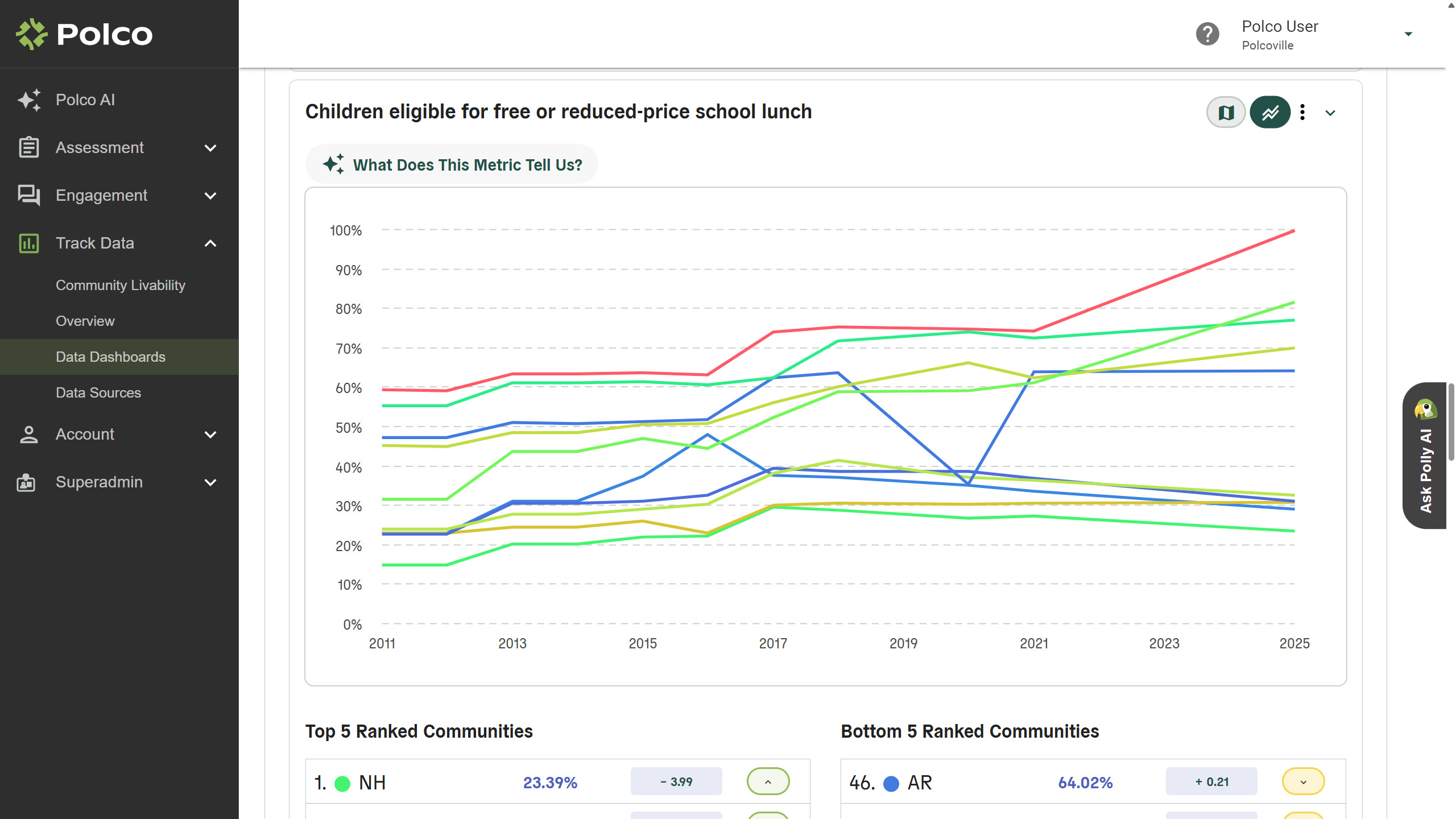
This is the shift from a single benchmark to a distribution. Polco's Track dashboards, built on the GPAL dataset, are designed for exactly this. GPAL pulls more than 400 data points for over 70,000 communities from trusted federal sources such as the U.S. Census Bureau, the Bureau of Labor Statistics, and the CDC, then organizes them into ten domains of community livability. You can view your community against similar-size communities, against your state, or against a custom group you build yourself. Each domain is scored on a 0 to 100 scale, so you see your position within the cohort rather than a lonely figure floating next to a national line.
That distribution is where realistic targets live. If most communities like yours score between 65 and 80 on a given domain, a goal of 95 is fantasy and a goal of 60 is retreat. The peer range shows you what good actually looks like for a place like yours.
Numbers need the resident voice
Objective data explains what is happening. It does not explain how residents feel about it, and those two things diverge more often than leaders expect. A community can post strong crime statistics and still have anxious residents, or hold modest park acreage and still have deep public affection for the parks it has.
This is why peer comparison should include sentiment, not just statistics. Polco's Benchmark Surveys, including The National Community Survey, measure resident satisfaction across the same ten livability domains and benchmark those results against peer communities using scientifically valid sampling. When you can see that your residents rate mobility below where residents in similar communities rate theirs, you have a finding you can defend and a target worth setting. The point is not to score well against strangers. It is to understand yourself in the company of your equals.
From defending numbers to setting direction
Better comparison is not about feeling good or bad. It is about making decisions you can stand behind. When a council member asks why a domain is underperforming, "we are below the national average" invites argument. "We are in the bottom quartile of communities our size, and here is the peer range we are aiming for" invites a plan.
That is the real cost of the national average. It keeps you reacting to a number that was never about you. Your true peers give you something better: a realistic picture of what is achievable, and a target you can actually hit.
Want to see where your community stands against its true peers? Explore Polco's Track dashboards or request a demo to build your own custom comparison group.


Are You Ready for a State Audit? How to Prove Your Programs Deliver ROI