By Polco on July 27, 2026

For years, "we asked the public" was enough to close a debate. A council could point to a packed hearing, a stack of comment cards, or an online survey, and call the input settled. That era is ending.
Elected officials, reporters, and residents now ask a harder question. Not "did you ask," but "who did you actually hear from, and how do you know they represent the community?" The scrutiny has moved from whether you gathered input to how you gathered it. That single shift raises the bar for every leader who wants public input to hold up under pressure.The good news is that meeting the new standard is not about collecting more comments. It is about collecting the right ones, in a way you can defend. Here is what that looks like.
The old standard rewarded volume. The new one rewards representativeness.
The old proof was turnout. A full room. A big response count. A survey with hundreds of clicks. Those numbers feel reassuring, but they answer the wrong question. A crowd is not a cross-section, and the loudest room is rarely the whole community.
Ashland, Massachusetts saw this clearly. Under its traditional town meeting format, decisions could only be made by residents who showed up at a set time and place. Those meetings skewed heavily toward older adults without children at home, leaving out working families juggling jobs, school pickups, and activities. As Assistant Town Manager Jenn Ball put it, that lack of involvement meant an unrepresentative sample was making many of the town's most consequential decisions.
That is the risk hiding inside high turnout. You can gather a lot of input and still miss most of your community.
Why the bar moved
Two forces pushed the standard higher.
First, leaders have been burned. Picture the familiar pattern. A city runs an open comment period, moves ahead on a project, and then faces a wave of residents and letters to the editor arguing the process was thin or the methods were opaque. The decision stalls or reverses, not because the idea was wrong, but because the proof behind it did not hold. Once that happens in a community, "we asked" stops being a shield.
Second, the audience for your methods has grown. Residents are more skeptical, local reporters are more willing to probe process, and opponents of any decision know that attacking the method is easier than attacking the merits. When the question becomes "how do you know," a comment count is not an answer.
What defensible input actually looks like
Input you can stand behind has four traits. Together they turn a pile of responses into evidence.
- A known sample, not just whoever showed up. The strongest input starts from a representative sample of the community, so the results reflect residents overall rather than the subset with the time and motivation to participate.
- Weighting to the real population. Even a good sample skews. Aligning results to actual community demographics, using sources like the U.S. Census and American Community Survey, keeps one group from speaking for everyone.
- Verified voices. Knowing that respondents actually live in your community, and being able to separate verified residents from general participants, lets you weigh input with confidence.
- Transparency you can point to. Clear methods, visible demographics, and an audit trail mean that when someone asks "how do you know," you have a one sentence answer instead of a shrug.
None of this requires abandoning open participation. It requires keeping the rigorous input and the open input in their proper places, so each does its job.
How this shows up in practice
This is the problem Polco was built to solve. The point of the rigor is defensibility. The goal is representative, statistically valid results that leaders can stand behind when setting budgets, priorities, and policy, rather than a read of whoever happened to respond.
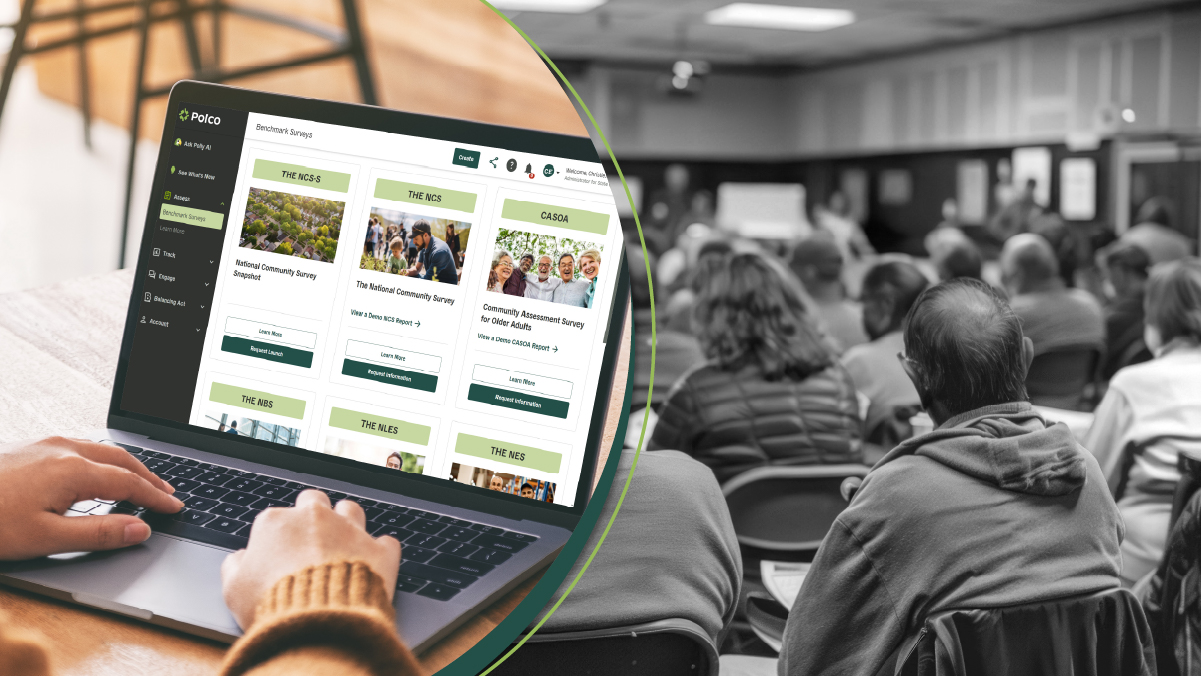
A Polco Benchmark Survey runs a probability based sample alongside open community participation, and stores the two separately so the scientific validity of the representative sample is preserved. Polco's data scientists apply demographic weighting aligned with Census and American Community Survey data, benchmark results against national averages and peer communities, and keep transparent audit trails. That is the difference between "residents told us" and "here is how we know this reflects the community."
The same backbone runs through everyday engagement. Polco's self serve tools carry built in demographics, automatic weighting, geographic views that show where responses came from, and a clear split between verified and unverified respondents. When residents rank priorities under real constraints in Prioritize, leaders can read the results by verified residents, by registered voters, or by demographic group, so the input is not just a total but a picture of who said what.
Gardena, California shows what that buys you. When the city built its first plan to address homelessness, it gathered resident input through Polco and carried that data straight into its City Council study session. The feedback did more than inform the plan. It helped justify the need to the council and supported the case for future grant funding. That is what input looks like when it is built to be shown.
The one question to ask before your next decision
Here is a simple test. Before you act on public input, ask yourself this. If a reporter asked how we know this reflects the community, could we answer in one clear sentence?
If the answer is turnout, you are still working from the old standard. If the answer describes a representative sample, weighting, and verified voices, you are ready for the scrutiny that is coming either way.
The bar has moved. "We asked" is table stakes now. "Here is how we know" is the new proof, and the communities that can say it will spend less time defending decisions and more time making them.
See how Polco helps you gather input you can stand behind.


Achieve Greater Representativeness With Online Survey Auto-Weighting

How to Write an Attention-grabbing Press Release About Your Data