

Belonging is Infrastructure: How Place, Connection, and Purpose Shape Community Well-Being
By Polco on August 31, 2026
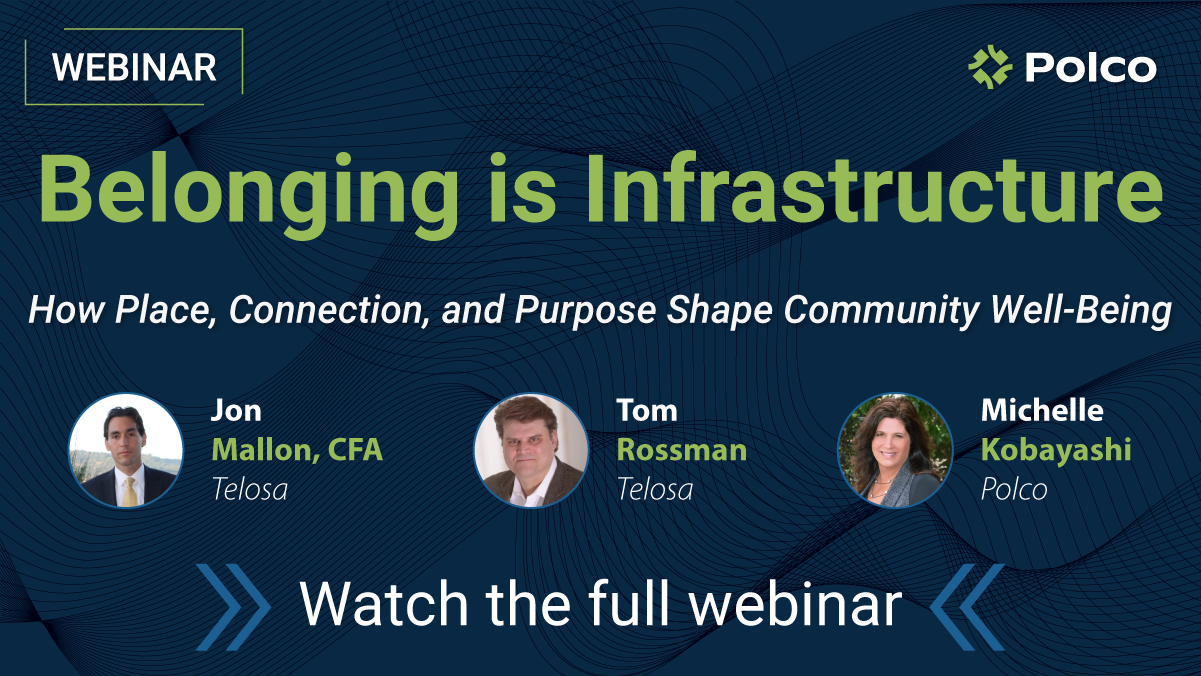
We tend to think of infrastructure as roads, bridges, pipes, and power lines — the physical systems that hold a community together. But there's another kind of infrastructure that shapes quality of life just as powerfully, and it rarely shows up in a capital budget: the network of relationships, gathering places, institutions, and opportunities that connect people to one another.
That was the central idea of our recent webinar, Belonging Is Infrastructure, co-hosted by Polco and the Telosa Community Foundation. Polco Executive Strategist Michelle Kobayashi was joined by Jon Mallon, CFA, CEO of the Telosa Community Foundation, and Tom Rossman, historian and senior advisor at Telosa and a board member of the Henry George School of Social Science. Together they made the case that belonging isn't a soft, feel-good extra — it's foundational, and it can be designed, built, and measured like any other system a community depends on.
Here's a recap of the conversation and the strategies local leaders can act on now.
What we mean by belonging
Belonging gets defined differently depending on who's using the word. Psychology frames it around relationships and acceptance; public health around connection and well-being; place around attachment and rootedness; civic life around voice and contribution. For the webinar, the speakers offered a working definition that pulls those threads together:
Belonging is the experience of being accepted, valued, and connected — to people, place, and shared purpose — and knowing you matter and can contribute.
When the systems that create that experience are strong, they support a long list of other community outcomes — trust, well-being, even reduced polarization. When they weaken, the effects ripple outward.
The national landscape: a belonging crisis
Tom Rossman walked through the long arc of American community life using Robert Putnam's "I–We–I" framework from Bowling Alone and The Upswing. Connection climbed through the first half of the 20th century, peaked in the early 1960s, and has been declining ever since — a shift from a "we" society back toward an "I" society.
The trust data is stark. Institutional trust has fallen from more than 70% in the early 1960s to roughly 30% today. Interpersonal trust followed the same path: where about 60% of people once said they could trust their neighbors, that figure has dropped to around 30% — and to just 19% among millennials. Over the same decades, Rossman noted, divorce rates more than doubled, births outside marriage tripled, violent crime tripled, and drug use expanded across large parts of the country.
Polco's own National Community Survey (The NCS) data shows a related pattern: belonging is holding steady, but it isn't strong. Nationally, only about 61% of residents rate their sense of community as excellent or good, 55% their connection and engagement, 61% neighborliness, and 59% civic and community pride. Those numbers have barely moved in a decade — a majority, but a middling one, well short of where communities want to be.
That disconnection doesn't stay personal. As Michelle Kobayashi explained, isolation ripples into mental health, substance misuse, housing and economic instability, and disengaged youth. The youth numbers are especially sobering: roughly 45% of high school students report feeling hopeless or despondent much of the time, and 18-to-24-year-olds now make up the demographic with the highest rate of clinically defined mental health disorders. Belonging, the speakers argued, can be a protective factor across all of these outcomes.
Four strategies to strengthen belonging
The heart of the webinar was practical: what can local governments and their partners actually do? The speakers organized their recommendations into four strategies.
1. Design communities for belonging
Physical and social infrastructure have a reciprocal relationship — the way a place is built either invites connection or blocks it. Rossman pointed to the Strong Towns concept of the "stroad" (a street widened into a car-dominated road) as an example of design that spreads people out, adds cost, and erodes the walkable, mixed-use districts where people naturally meet. The alternative — compact, walkable, "15-minute city" design — not only strengthens connection but tends to generate more revenue per acre and higher quality of life. Harrisburg, Pennsylvania was cited as a community that grew its downtown and population dramatically after reforms in this direction.
The national data underscores the gap: average commutes run about 26 minutes, only 3% of employed people walk to work, and walkability, job access, and compact-neighborhood scores all fall well below their potential. Placemaking works best when it combines three things: policies that make gathering possible (flexible zoning, simple permits, shared use of schools and civic spaces), programs that bring spaces to life (markets, festivals, walking clubs, pop-up plazas), and physical structures that give connection a home (parks, seating, libraries, community gardens).
2. Mobilize the community for belonging
Belonging needs people and organizations to actively create and maintain relationships — and local government can't and shouldn't do it alone. With budgets tight and public expectations high, partnerships with nonprofits, the private sector, and faith-based organizations are essential. Partners extend reach (connecting with residents government may not), trust (working through familiar messengers), capacity, coordination, and staying power beyond any single event or grant.
The webinar offered a simple menu for these partners to work from: welcome (new-resident greetings, neighborhood ambassadors), gather (block parties, festivals, community meals), connect (walking groups, clubs, intergenerational programs), contribute (volunteer days, skill-sharing, mentoring), and shape (participatory budgeting, listening sessions, mini-grants). One practical insight: today's volunteers, especially baby boomers, want their specific skills to matter — so matching people to roles they care about beats simply recruiting bodies. And older adults, as Polco's CASOA data shows, feel the effects of disconnection especially acutely, making connection both an opportunity gap and a well-being issue.
3. Invest in mental health
Rossman connected belonging directly to the rise in "deaths of despair" — the work of Nobel laureate Angus Deaton — and the shared underlying conditions of isolation, trauma, and lost purpose. Communities can respond at every stage: building protective factors through welcoming spaces and civic roles, making early help easy to access through counseling in schools and libraries and culturally responsive care, and responding quickly in crisis and recovery with tools like 988 awareness and mobile crisis teams. The through-line is prevention: intervening early is far better for the person and far less costly for the community. As the near-century-long Harvard longitudinal study found, the single strongest predictor of longer, happier, more successful lives is the number of a person's social connections.
4. Assess belonging and map community assets
Cities know a great deal about their roads, budgets, and housing — and far less about whether residents feel connected, trust each other, or believe they belong. As Jon Mallon put it, we measure what we value, and measurement is what turns good intentions into action. That's the purpose of the Community Connections Guidebook that Polco and Telosa developed together, along with its companion assessment. Built from literature reviews, national data modeling, and global case studies, it helps a community rate itself across six reinforcing dimensions — social cohesion, equity and inclusion, civic participation, social participation, strong institutions, and placemaking — and then decide, together, where to focus first.
When Polco and Telosa asked city managers at a recent ICMA conference to score their own communities using this index, social belonging rated highest (66 out of 100) while placemaking and civic participation rated lowest (52 and 54). The pattern points leaders toward the physical and civic conditions that most need strengthening — and reinforces the webinar's core message: no single dimension creates belonging on its own. The strength comes from how they work together.
Get started in your community
Belonging is infrastructure — and like any infrastructure, it can be assessed, planned, and built. The best place to begin is by understanding where your community stands today.
Download the Community Connections Guidebook.
Our free guidebook and assessment give you and your partners a structured way to measure community connection, establish a baseline, and identify where to take action first.
Get the guidebook here →
Learn how Polco can help.
Polco's engagement and analytics platform helps local governments and community organizations hear resident voice, benchmark against national data, and turn insight into action on belonging and beyond.
Request a demo →
Connect with Telosa.
The Telosa Community Foundation researches and shares publicly available resources on community development, placemaking, and social connection — and is piloting the Community Connections Index with cities.
Reach out to Telosa →
Popular posts
Sign-up for Updates
You May Also Like
These Related Stories
Best in Governance Awards: Where Parks Bring Communities to Life