

Dashboard Theater: How Local Governments Can Turn Metrics Into Meaningful Action
By Polco on May 22, 2026
Local governments are producing more dashboards than ever before. Strategic plans. Budget dashboards. KPI trackers. Community indicators. Internal workflow metrics. The technology has evolved rapidly, and communities now expect real-time visibility, transparency, and accountability.
But there is a growing challenge hiding behind all those charts and graphs.
What happens when dashboards look impressive but fail to change decisions?
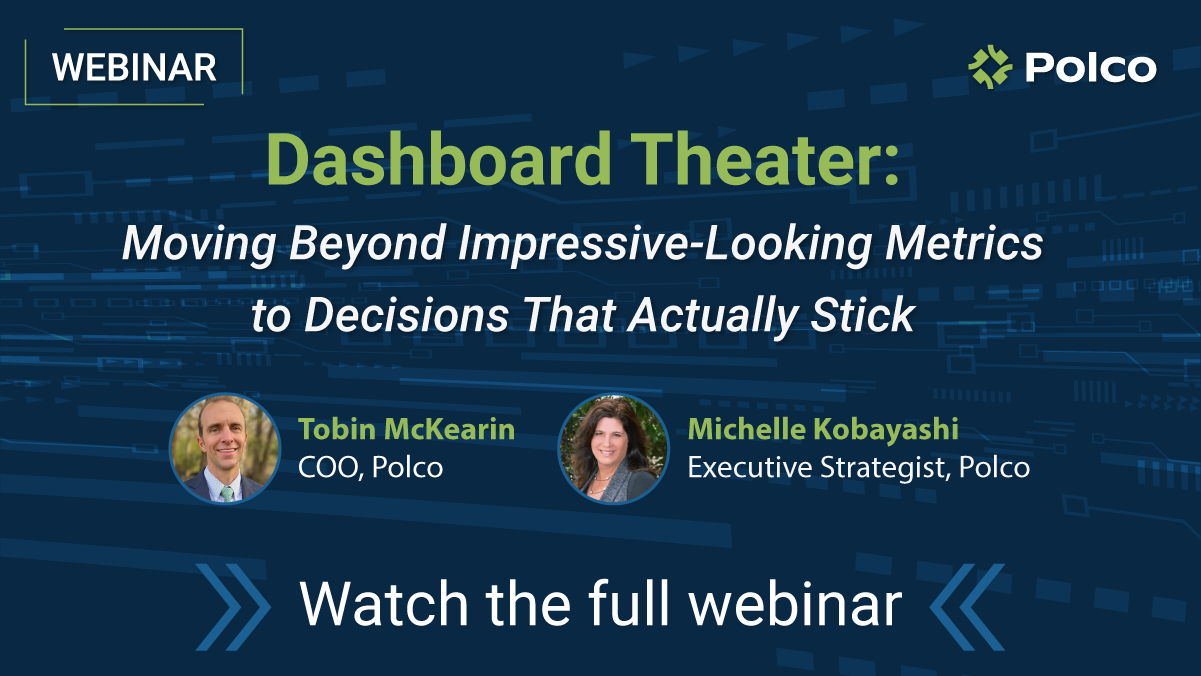
That was the central question explored during Polco’s recent webinar, Dashboard Theater: Moving Beyond Impressive-Looking Metrics to Decisions That Actually Stick, led by Polco COO Tobin McKearin and Executive Strategist Michelle Kobayashi.
The conversation focused on a problem many public sector leaders recognize immediately: organizations are collecting more data than ever, but too often the dashboards become the performance instead of the tool for improvement.
As Michelle Kobayashi explained during the webinar, dashboard theater happens when “the dashboards become the center of the show, rather than what comes from those dashboards.”
Dashboards Are Everywhere. Decisions Are Not.
The webinar opened with a candid discussion about how dramatically performance measurement has changed in local government.
A decade or two ago, benchmarking and performance measurement were largely limited to a small group of highly data-driven organizations. Communities would collect information manually, send it to a university or benchmarking consortium, and wait months for spreadsheets to come back.
Today, dashboards are everywhere.
According to the presenters, local governments are now using dashboards for:
- Strategic planning
- Budgeting and resource allocation
- KPI tracking
- Department operations
- Community livability indicators
- Resident-facing transparency tools
The challenge is no longer simply presenting information. The challenge is turning information into action.
The Webinar’s Eight Strategies for More Actionable Dashboards
A major focus of the webinar was eight practical strategies local governments can use to move beyond “dashboard theater” and create systems that genuinely improve decision-making.
The presenters encouraged attendees to:
- Reduce cognitive overload by simplifying dashboards and eliminating unnecessary metrics.
- Use context like benchmarks and trend lines to make data meaningful.
- Design dashboards to spark conversations, not passive monitoring.
- Build dashboards collaboratively so stakeholders actually use them.
- Focus on outcomes instead of activity metrics.
- Select metrics tied directly to decisions and community priorities.
- Minimize the burden of data collection through automation and fit-for-purpose measurement.
- Build a culture of learning, transparency, and innovation.
Together, these strategies create dashboards that are not only visually useful, but operationally transformative.
Why So Many Dashboards Fall Short
One of the webinar’s most valuable moments came when the presenters outlined the most common reasons dashboards fail operationally, even when they succeed visually.
The presentation identified six recurring issues:
1. Too Much Information
Organizations often overload dashboards with every available metric. Instead of creating clarity, the result is confusion and decision fatigue.
2. Weak Connection to Real Decisions
Some metrics are easy to collect but have little connection to meaningful policy or operational decisions.
3. Psychological Safety Challenges
Employees may hesitate to discuss poor results openly if they fear judgment or punishment.
4. Low Trust in the Data
If stakeholders question the accuracy, methodology, or ownership of the data, dashboard adoption suffers.
5. “Hit-and-Run” Evaluation
Too many dashboards present information without helping teams determine what to do next.
6. Siloed Daily Work
Dashboards often feel disconnected from actual operational workflows, making them feel like extra work instead of useful tools.
The webinar summarized the issue perfectly:
“Many dashboards succeed visually before they succeed operationally.”
The Shift From Activity Metrics to Outcome Metrics
One of the strongest themes throughout the webinar was the need to stop measuring activity and start measuring outcomes.
Dr. Tobin McKearin emphasized that many organizations still focus heavily on metrics like:
- Number of meetings held
- Dollars spent
- Programs launched
- Website visits
- Reports produced
While those indicators may show activity, they do not necessarily reveal whether conditions are improving for residents.
Instead, leaders should focus on questions like:
- Are outcomes improving?
- Are residents better off?
- Are disparities shrinking?
- Are strategies actually working?
- What needs to change?
As the webinar presentation stated:
“Good dashboards measure progress.”
The presenters used housing policy as an example. Rather than tracking dozens of disconnected housing indicators, communities should focus on metrics that directly connect to decisions and outcomes, such as:
- Are enough housing units being permitted?
- What is the current housing shortfall?
- What percentage of renters are cost burdened?
Those metrics tell a story leaders can act on.
Reducing Cognitive Overload
The webinar’s first strategy focused on reducing cognitive overload.
Tobin McKearin explained that many organizations unintentionally overwhelm users by cramming too many metrics, charts, and data points into a single dashboard. Instead of improving understanding, overloaded dashboards often create confusion and decision paralysis.
The presenters emphasized that “less is more” when it comes to dashboard design. Clearer dashboards help leaders focus on what matters most and make faster, more confident decisions.
One practical recommendation was to move secondary or supporting information into appendices or drill-down sections rather than placing everything on the main dashboard at once.
The goal is not maximum information density.
The goal is maximum clarity.
Context Is What Makes Data Actionable
Another key lesson from the webinar was that numbers alone rarely create clarity.
Context transforms metrics into insights.
Michelle Kobayashi encouraged attendees to think beyond snapshots and focus instead on:
- Benchmark comparisons
- Historical trends
- Peer community comparisons
- Regional context
According to the webinar, trend lines are often the most important indicator because they show whether a community is improving or declining over time.
This philosophy aligns closely with Polco’s GPAL-powered Track dashboards, which help communities compare local performance against national benchmarks, peer jurisdictions, and historical trends. The platform integrates data from hundreds of trusted public datasets, including the U.S. Census Bureau, CDC, Bureau of Labor Statistics, FEMA, HUD, and many others.
The webinar also demonstrated how simplified, outcome-focused dashboards help reduce clutter while still allowing leaders to drill deeper into specific metrics when needed.
Culture May Matter More Than Technology
Perhaps the webinar’s most important message had nothing to do with dashboard software at all.
It was about organizational culture.
Michelle Kobayashi stressed repeatedly that dashboards cannot succeed in cultures driven by fear, punishment, or defensiveness.
In “judging cultures,” she explained, data is often used to criticize people, which creates anxiety, avoidance, and even manipulation of metrics.
In contrast, “learning cultures” treat data as a tool for understanding and improvement. Teams feel safer experimenting, discussing challenges openly, and focusing on long-term outcomes rather than short-term appearances.
The presenters encouraged local governments to create environments where:
- Curiosity is rewarded
- Innovation is encouraged
- Employees feel psychologically safe discussing poor results
- Leadership models transparency and learning
- Dashboards are integrated into everyday decision-making
As one attendee shared during the discussion, dashboards work best when leaders “shift language to transparency and curiosity.”
Reducing the Burden of Performance Measurement
Another practical takeaway involved reducing the operational burden associated with dashboard management.
The presenters acknowledged that many organizations spend too much time collecting, aggregating, and managing low-value metrics.
Instead, communities should:
- Focus only on metrics tied to decisions and outcomes
- Automate data collection whenever possible
- Minimize manual reporting burdens
- Use publicly available baseline datasets
- Prioritize “fit-for-purpose” metrics
Polco’s GPAL framework was highlighted as one way communities can streamline this work by providing centralized access to trusted public sector data and benchmarking tools.
The broader goal is not to collect more data.
It is to make better decisions with less friction.
AI Can Help Communities Select Better Metrics
Another emerging theme from the webinar was the growing role of AI in performance management.
The presenters discussed how AI tools like Polco’s Polly assistant can help communities identify stronger metrics, evaluate trends, and even recommend evidence-based programs tied to local priorities.
Instead of manually sorting through dozens of possible indicators, leaders can increasingly use AI to:
- Identify the most actionable performance metrics
- Surface important trends more quickly
- Recommend best-practice interventions
- Connect resident priorities to measurable outcomes
- Reduce time spent manually analyzing data
The webinar framed AI not as a replacement for leadership, but as a decision-support tool that helps governments focus attention where it matters most.
Turning Dashboards Into Conversations
One of the most compelling strategic shifts discussed in the webinar was moving dashboards away from passive monitoring and toward active organizational dialogue.
Traditional dashboards often become static reporting tools.
People look at them briefly, acknowledge the numbers, and move on.
The presenters challenged attendees to instead build dashboards that spark questions such as:
- What are we seeing?
- Why does it matter?
- What is driving this trend?
- What decisions should we make next?
When dashboards become conversation tools rather than reporting tools, organizations create shared understanding and stronger alignment around community priorities.
The Future of Public Sector Performance Management
Throughout the webinar, one theme remained consistent: communities do not need more data for the sake of data.
They need clarity.
Polco’s broader mission is to help governments unite people, data, and government to improve community quality of life through better decisions. That philosophy was reflected throughout the presentation.
The future of performance management is not about building prettier dashboards.
It is about:
- Connecting metrics to outcomes
- Embedding data into operational workflows
- Building cultures of learning and innovation
- Empowering leaders with context-rich insights
- Strengthening trust through transparency and action
As Tobin McKearin concluded during the webinar, if organizations fail to create a culture that genuinely wants to use data, “you’re probably not going to succeed, no matter whether you measure everything perfectly.”
That may be the most important lesson of all. Dashboards do not transform communities. People do.
Popular posts
Sign-up for Updates
You May Also Like
These Related Stories
.png)
Taming the Social Media Beast

Countdown to the Future: 10 Mega Trends Shaping Cities and Communities