

By Polco on January 8, 2026
Picture this: It's a typical Monday morning in Dallas, and the public records team is staring at their inbox. Again. Another few hundred requests have come in over the weekend, residents asking for meeting minutes, businesses requesting permit records, journalists seeking budget documents, attorneys filing discovery requests.
By the end of the year, Dallas will process over 60,000 public records requests. Manually.
Each one requires someone to read the request, figure out which department might have the information, track down the right files (some digital, some paper, some in that filing cabinet that Susan used to manage before she retired), review everything for redactions, compile it, and send it back. All while handling phone calls from people asking "where's my request?"
The technology exists to automate most of this. Dallas knows it. But like thousands of other jurisdictions across America, they're caught in a perfect storm: aging systems, retiring workforce, exploding demand, and no clear path forward.
And Dallas isn't alone. Not even close.
The Pattern Nobody Wants to Talk About
When we started analyzing strategic plans and technology assessments from cities and counties across America, we expected to find regional differences. Maybe coastal cities would have different problems than Midwest towns. Maybe large urban centers would face different challenges than rural counties.
We were wrong.
From rural Idaho to major East Coast cities, from small townships to major metropolitan areas, the same problems kept appearing:
In Albuquerque, city leaders describe their current data infrastructure as a "digital trashcan", information goes in, but there's no way to retrieve, analyze, or actually use it for decision-making.
In Santa Fe County, staff are manually transferring data between systems via email. Financial workflows are managed in spreadsheets. Invoice packets are assembled and entered by hand.
In Fairfax County and Richland County, South Carolina, the volume and complexity of public records requests have become overwhelming. They're desperately seeking automation, even exploring mobile app integration just to handle the flood.
In Oakland, the Business Information and Analytics division is struggling to integrate data from multiple disconnected systems. They can see pieces of the picture, but never the whole thing.
In DeKalb County and Roseville, California, staff are spending countless hours on manual redaction processes, reading through documents line by line, blacking out sensitive information by hand (or with basic PDF tools), knowing that one mistake could be a legal liability.
Different states. Different sizes. Different budgets. Same problems.
Five Threads Running Through Every Story
As we reviewed strategic plans, budget documents, and technology roadmaps from over 150 jurisdictions, five themes emerged so consistently that we started calling them the "Five Critical Technology Imperatives."
Every single community is wrestling with some version of these challenges:
1. The Integration Crisis
Governments are drowning in disconnected software. The permitting department uses one system. Finance runs on a decades-old platform. Community development tracks projects in spreadsheets. Public works has its own tool. None of them talk to each other.
Staff waste hours every day manually moving data between systems. Residents get conflicting information depending on which department they contact. And leadership is making multi-million dollar decisions without being able to see the full picture.
Stockton is working to connect their permitting system with their electronic records system. Redondo Beach cites "siloed operations" between Building and Planning causing inefficiencies. Ramsey County is finally replacing a heavily customized, 20-year-old system that's held together with duct tape and prayers.
2. The Engagement Gap
Tuesday at 7 PM town halls are dying. And for good reason, they only work for a narrow slice of the population. Meanwhile, working parents, shift workers, and residents without reliable childcare are systematically excluded from civic conversation.
Denton, Texas is investing in software to gather truly representative community sentiment. Austin allocated $75,000 specifically to hear from the "silent majority" rather than governing based solely on who can make Tuesday night meetings. Durham is using technology to reach historically underserved communities that traditional bureaucratic processes have alienated.
Governments are making million-dollar decisions based on feedback from dozens of voices while claiming to represent tens of thousands of residents.
3. The Transparency Trap
When governments can't easily explain where money goes or why projects take so long, residents fill the void with speculation and conspiracy theories. Social media amplifies misinformation faster than agencies can respond with facts.
San Francisco notes that confusing, conflicting, and missing information about project timelines leads to massive uncertainty for applicants. Denver and Philadelphia hear constant complaints about the "Black Box" problem, plans go in, nothing comes out, no one knows what's happening.
Sacramento's Animal Care Services discovered that inconsistent data on their public portal was actively undermining public trust. Bad transparency is sometimes worse than no transparency.
4. The Data Desert
Government leaders are making multi-million dollar investment decisions based on anecdotal evidence, outdated benchmarks, and institutional intuition rather than hard data.
Redondo Beach has no standardized performance reports for development review processes and no formal tools for measuring customer satisfaction. Santa Clara County lacks mechanisms for tracking customer feedback on building permits. Boston Public Health Commission needs dashboards to manage grants, monitor compliance, and track recruiting, but doesn't have the infrastructure.
Colorado Springs can report on "outputs", dollars spent, beds created, but struggles to measure "outcomes" like long-term housing stability. And without outcome data, they can't prove what's actually working.
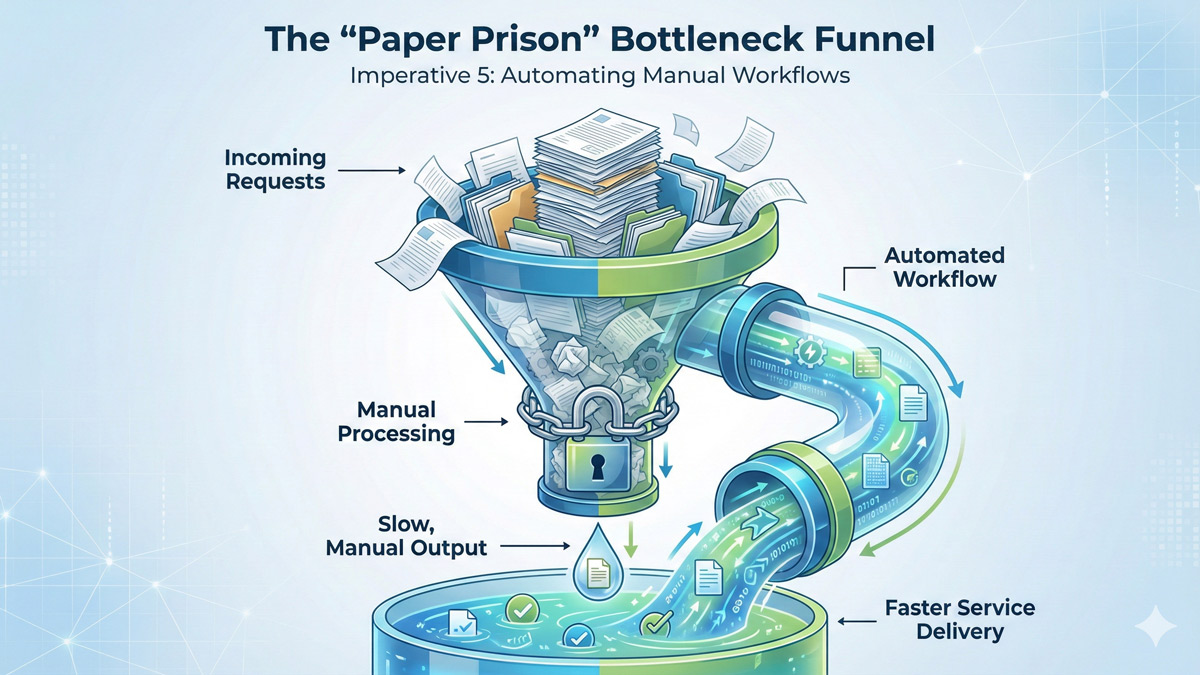
5. The Manual Process Trap
In 2025, it's remarkable how much government work still happens on paper, in email chains, and through manual data entry.
Long Beach's outdated HR and payroll systems cause constant inefficiencies and user frustration. El Paso County's system forces staff to rely on external spreadsheets just to see their own data. Staff across the country are manually retrieving old documents for public requests, manually tracking development projects, manually reconciling financial data.
When processes live in email and filing cabinets, they're vulnerable to staff turnover. When requests require manual tracking, they get lost. When workflows depend on physical handoffs, they create bottlenecks.
The Perfect Storm
Here's why this matters right now, and why jurisdictions can't afford to wait another budget cycle:
The Money Is Running Out
American Rescue Plan Act (ARPA) funding provided a financial cushion that allowed many governments to defer difficult modernization decisions. That money is expiring. The next budget cycle won't have that safety net.
Every dollar now needs to be justified with data. Every position needs to demonstrate measurable impact. Governments that can't prove their programs work will face impossible budget decisions.
The Workforce Is Retiring
The "Silver Tsunami" of Baby Boomer retirements isn't coming, it's here. Across America, experienced government workers are leaving, taking decades of institutional knowledge with them.
When the person who "knows how things work" retires, that knowledge walks out the door. New employees struggle to get up to speed. Processing times increase. Errors multiply. Service quality declines.
And here's the harder truth: governments can't recruit the next generation of public servants if the technology looks like it's from 2005. Young professionals who grew up with smartphones and cloud software aren't excited about jobs that involve fax machines and paper filing systems.
Resident Expectations Are Skyrocketing
Residents have been trained by Amazon, Uber, and their banking apps to expect three things: instant service, real-time tracking, and 24/7 access.
When government can't deliver that same experience, residents don't just get frustrated, they start questioning whether government can deliver anything effectively. The trust gap grows. Engagement drops. And communities become harder to govern.
Why This Moment Is Actually an Opportunity
Here's what makes this different from every other "government needs to modernize" article you've read:
The path forward is now clear.
For years, the challenge was that nobody knew what "good" looked like. Early adopters were experimenting, trying different approaches, sometimes succeeding and sometimes wasting money on shiny tools that didn't solve real problems.
But now? We have enough success stories to identify patterns. We know what works. We know what order to tackle things in. We know which investments pay off quickly and which require longer timelines.
Cities that embrace integrated systems, modern engagement tools, radical transparency, data-driven decision-making, and workflow automation are already seeing results: higher resident satisfaction, more efficient operations, and renewed public trust.
The technology has caught up to the need.
AI systems can now review permit applications against complex technical requirements, work that used to require senior staff can now be handled instantly, 24/7. Integration platforms can connect legacy systems without expensive rip-and-replace projects. Cloud-based tools make sophisticated analytics accessible to jurisdictions of any size.
The barriers aren't technical anymore. They're strategic: knowing where to start, how to build a roadmap, and how to make the case for investment.
The crisis is forcing action.
Sometimes the best time to make hard changes is when you don't have a choice. The convergence of expiring ARPA funds, retiring workforce, and rising expectations means that doing nothing is no longer an option.
Governments have to modernize, not to innovate, but to survive. And when change is inevitable, the only question is whether you'll lead it or be forced into it.
What We Found (And What's Coming Next)
We spent months analyzing publicly available strategic plans, budget documents, and technology assessments from mid-sized cities, major urban centers, and counties across the United States. Over 150 jurisdictions. Thousands of pages of documents.
The findings were both sobering and hopeful.
Sobering because the problems are deeper and more widespread than most people realize. This isn't a few struggling rural counties or a handful of cities with bad leadership. This is a systemic challenge affecting communities of every size and geography.
Hopeful because the solutions are proven and achievable. The governments that are succeeding aren't the ones with unlimited budgets or massive IT departments. They're the ones making strategic choices, starting with high-impact changes, and building momentum over time.
Over the next few weeks, we'll be diving deep into each of the five imperatives:
- Why your government has 47 software systems that don't talk to each other (and the integration strategies that actually work)
- How Tuesday at 7 PM is killing democracy (and what modern community engagement looks like)
- The Black Box problem (and how transparency rebuilds trust)
- Why gut-feel governance is over (and how data-driven decision-making transforms operations)
- The paper prison (and how workflow automation frees your team to do meaningful work)
We'll share specific examples, practical roadmaps, and the questions every leader should be asking. No vendor pitches, no theoretical frameworks, just evidence-based guidance from jurisdictions that are successfully navigating this transformation.
The Question That Matters
Dallas will process 60,000 public records requests this year. Manually.
Your jurisdiction might not face that exact challenge. Maybe for you, it's the permitting backlog. Or the inability to track program outcomes. Or the resident complaints about transparency. Or the knowledge walking out the door with retiring staff.
But the underlying question is the same: Can your government keep operating the way it always has?
The honest answer, for most jurisdictions, is no.
The good news? You don't have to figure this out alone. The roadmap exists. The technology exists. The success stories exist.
We'll be sharing all of it, starting now.
Want the complete analysis?
 Download our white paper: The Connected Community: 5 Critical Technology Imperatives for Modern Local Governments. It includes detailed findings from 150+ jurisdictions, specific implementation strategies, and the framework for building your modernization roadmap.
Ready for practical guidance?
 Join our free webinar on January 14, 2026, where we'll walk through the transformation blueprint with real examples, ROI data, and time for your questions.
Because the 60,000-request problem isn't just about public records. It's about whether government can keep up with the communities it serves.
At Polco, we're helping local governments navigate this transformation with AI-powered tools that work 24/7, from permitting agents that understand complex regulations to institutional intelligence models that preserve decades of knowledge. The future of government isn't about working harder. It's about working smarter. Let's talk about what that looks like for your community.

The People Have Spoken: Honoring America’s most Trusted Local Governments

Top Eight Local Government Innovations As We Emerge From COVID-19