

By Polco on June 25, 2026

Local governments often ask whether younger generations view government differently than older residents. The answer is yes, but perhaps not in the ways many assume.
Data from Polco's National Community Survey (The NCS), representing more than 500 communities nationwide and the opinions of over 33 million Americans, reveals a consistent pattern: trust and confidence in local government generally increase with age.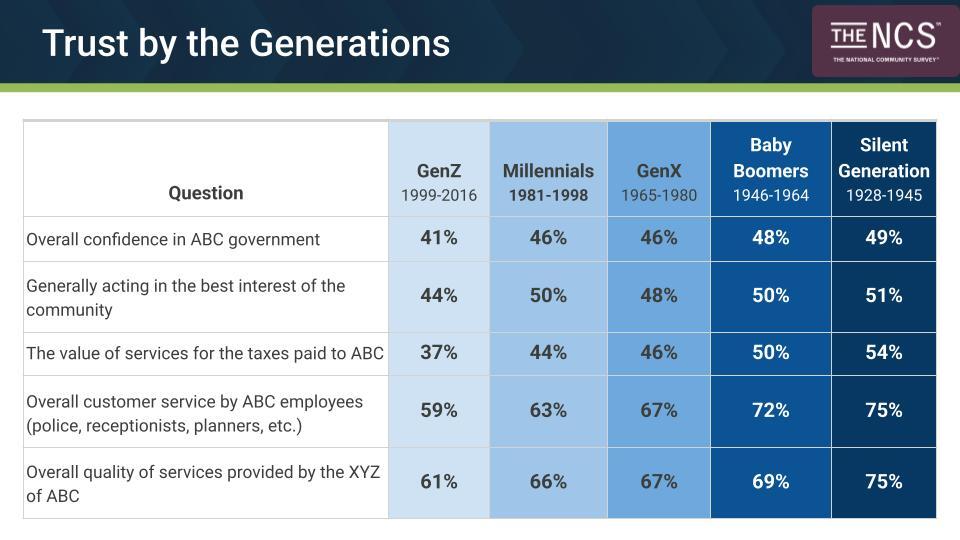
While younger residents tend to be less positive across most measures, the differences are not dramatic. In fact, residents of all generations report relatively strong satisfaction with the direct services they experience, while confidence in government institutions remains more modest.
Younger Residents Are More Skeptical
Across every measure included in this analysis, Gen Z residents report the lowest levels of positive sentiment.
Only:
- 41% express overall confidence in their local government.
- 44% believe the government acts in the best interest of the community.
- 37% believe they receive good value for the taxes they pay.
By comparison, Silent Generation residents report confidence levels ranging from 49% overall confidence to 54% satisfaction with value for taxes paid.
The largest gap appears around perceived value for taxes paid, where there is a 17-point difference between Gen Z and the Silent Generation.
These findings suggest younger residents may be more critical consumers of government services and more demanding of transparency, accountability, and demonstrated results.
Trust Is Lower Than Service Satisfaction
One of the most interesting findings is the distinction between trust in government and satisfaction with government services.
Across every generation:
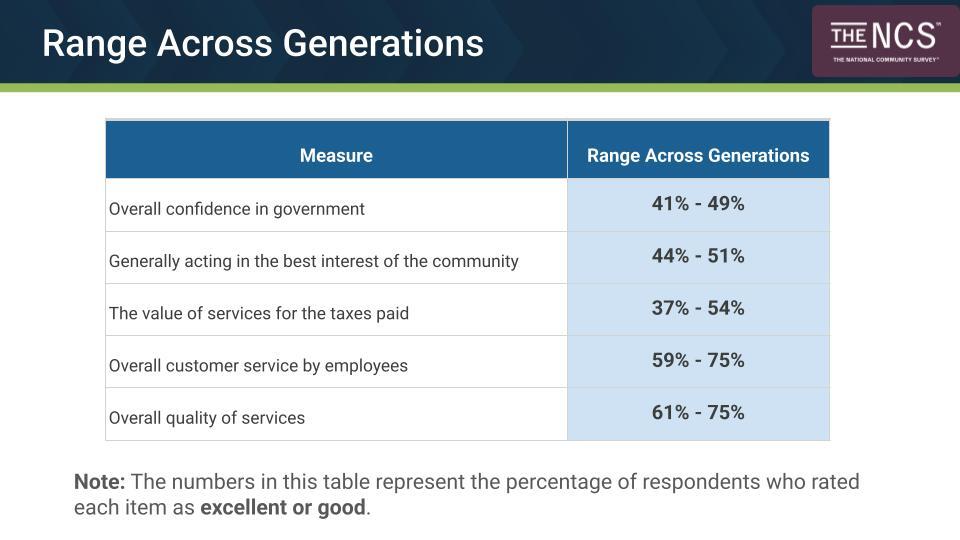
Residents consistently rate their interactions with government employees and the quality of local services much higher than they rate government as an institution.
This pattern appears repeatedly in local government research. Residents often appreciate the work of police officers, planners, parks staff, utility workers, librarians, and customer service representatives while remaining more cautious about government broadly.
In other words, people frequently trust the people they interact with more than the institution itself.
Why Do Older Generations Report Higher Trust?
One explanation is that generations develop distinct attitudes based on the social, political, and economic environments in which they come of age.
The Silent Generation and Baby Boomers grew up during periods when confidence in government and other major institutions was generally higher. Gen Z, by contrast, has come of age during an era characterized by political polarization, social media, economic uncertainty, and declining trust in many institutions. These experiences may shape expectations about government and influence how residents evaluate public services and leadership.
Younger generations also tend to have different expectations. They are more likely to expect transparency, rapid communication, digital accessibility, and opportunities for direct participation in decision-making. As a result, they may evaluate local government through a different lens than older residents.
At the same time, some of these differences may simply reflect life stage.
Older residents often have deeper roots in their communities. They may have lived there longer, interacted with local services more frequently, and experienced the benefits of long-term public investments. They also tend to vote and participate in civic activities at higher rates.
Younger residents are often newer to their communities, may be less familiar with the responsibilities of local government, and may have had fewer opportunities to see how public decisions affect their daily lives over time.
The reality is likely a combination of both factors. Some differences may be tied to the unique experiences that shape each generation, while others may change naturally as residents age and become more engaged in their communities.
Regardless of the cause, the message for local governments is clear: younger residents often have different expectations about how government should communicate, engage, and demonstrate value. Communities that adapt to those expectations will be better positioned to build trust across generations.
What Local Governments Should Do
The findings highlight an important challenge for local leaders.
Improving trust may require more than delivering quality services. It also requires helping residents understand what the government does, how decisions are made, and how public investments create value.
Strategies that appear particularly important for younger residents include:
- Communicating outcomes and performance data transparently, not just listing activities.
- Demonstrating how tax dollars are used.
- Meeting residents on the specific digital platforms they actually use, not just posting updates online.
- Creating meaningful opportunities for resident participation, and closing the loop by reporting back what happened as a result of their input.
- Maintaining steady, proactive communication during calm periods, not just activating during crises.
- Acknowledging mistakes and setbacks openly, rather than only publicizing successes.
The data suggest that younger residents are not disengaged. They are simply harder to convince.
The Opportunity
Perhaps the most encouraging finding is that even among Gen Z, service ratings remain relatively strong. Nearly 6 in 10 younger residents rate customer service positively, and 61% rate overall service quality positively.
That means the foundation for trust already exists.
The challenge for local governments is connecting positive service experiences to broader confidence in government itself. Communities that can successfully demonstrate value, communicate results, and engage residents authentically may be best positioned to narrow the generational trust gap in the years ahead.
About the Data
These results are drawn from Polco's National Community Survey (NCS), the nation's largest benchmarks of resident opinion related to local governance and community livability. The analysis includes data from more than 500 communities across the United States, representing the views of over 33 million residents. Results shown reflect the percentage of residents rating each item positively within their generation.
Want to Know How Your Community Compares?
Trust isn't built through assumptions. It's built through listening.
Polco's National Community Survey® (The NCS®) helps local governments measure resident confidence, satisfaction, and priorities across every generation using scientifically representative survey methods and national benchmarks. See how Gen Z, Millennials, Gen X, Boomers, and older residents experience your community differently, identify where trust gaps exist, and uncover opportunities to strengthen engagement.
Because when you understand what matters to each generation, you can communicate more effectively, demonstrate greater value, and build lasting trust.
Learn how The National Community Survey can help your community make more informed, resident-centered decisions.

Announcing the 2025 Best in Governance National Champions
How Local Governments Can Partner with Residents for a Better COVID-19 Recovery