

By Polco on June 15, 2026
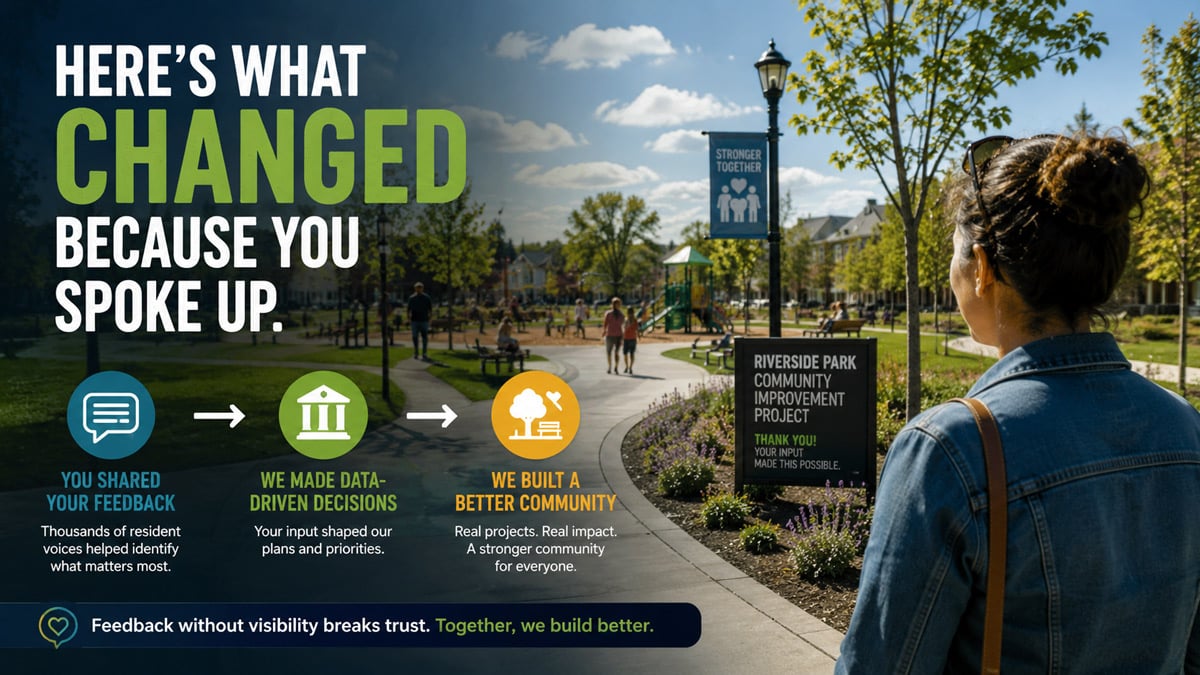
Every local government says it values community feedback. The real question is this: Can residents actually see the impact of their input?
Too often, public engagement ends where frustration begins: a survey closes, a town hall wraps up, residents submit ideas, concerns, and priorities, then hear nothing for months. Or worse, they never hear back at all. That creates one of the biggest risks in civic engagement today: performative participation.
When residents feel their feedback disappears into a black hole, trust erodes quickly. People stop participating, skepticism grows, and future engagement efforts become harder and more expensive.
Collecting feedback is only half the job. The other half is showing residents how their voices shaped real decisions, policies, and outcomes. That is where trust is built.
Residents Do Not Expect Government to Agree With Everyone
Here’s an important truth many leaders overlook: Residents do not expect every comment to become policy. Most people understand that governments face budget constraints, legal limitations, competing priorities, and complex trade-offs. What residents do expect is transparency.
They want to know:
- Was my feedback heard?
- Did leaders seriously consider it?
- What did the community say overall?
- How did that input influence the final decision?
- What happens next?
When governments answer those questions clearly, engagement feels meaningful, even when outcomes are imperfect. When they do not, engagement feels transactional, or worse, symbolic.
Visibility Is What Makes Engagement Feel Real
The most effective public engagement strategies do not stop at collecting input. They create visible connections between feedback and action. Residents should be able to trace a clear line from: Community Input → Government Decision → Public Outcome. That visibility changes how communities perceive local government.
Instead of wondering whether participation matters, residents begin seeing evidence that it does. And once communities believe engagement leads to action, participation grows naturally.
Why the “Closing the Loop” Phase Matters Most
Many governments invest heavily in surveys, outreach campaigns, public meetings, and engagement tools. Far fewer invest in what happens afterward. But the post-engagement phase is often the most important part of the entire process.
Polco’s engagement guidance emphasizes the importance of sharing results transparently, reporting back to residents, and maintaining ongoing communication after surveys conclude.
That includes:
- Publicly sharing key findings
- Explaining next steps
- Providing project updates
- Tracking outcomes over time
- Showing how feedback influenced decisions
Without those follow-ups, even successful engagement efforts can feel incomplete.
The Best Engagement Strategies Make Decisions Easy to Understand
One major challenge in local government communication is complexity: budgets are complicated, infrastructure projects take years, or policy trade-offs are difficult to explain. Residents often do not see the full context behind decisions. That is why visual communication matters.
Modern civic engagement platforms help governments transform dense information into accessible, understandable experiences through:
- Dashboards
- Data visualizations
- Interactive reports
- Project pages
- Budget simulations
- Priority ranking tools
- Ongoing content updates
Polco’s Resident Feed centralizes updates, surveys, projects, and visual content into one easy-to-access experience for residents. Instead of requiring residents to search through agendas or PDFs, governments can continuously show progress in real time. That visibility reinforces accountability.
Residents Want Progress Updates, Not Just Final Announcements
One of the biggest communication mistakes governments make is waiting until a project is complete to talk about it. Residents benefit from seeing the process unfold.
Even small updates matter:
- “Here’s what we heard.”
- “Here’s what we’re evaluating.”
- “Here’s why this option was selected.”
- “Here’s the timeline moving forward.”
- “Here’s what changed because of your feedback.”
These updates create momentum and trust. They also help residents understand that meaningful change often takes time. Transparency is not just about final outcomes, it is about ongoing visibility.
Data Builds Confidence in Difficult Decisions
Some community decisions are controversial no matter what leaders choose: housing development, budget trade-offs, transportation changes, or public safety investments. In those moments, resident feedback data becomes especially valuable.
Representative engagement helps leaders explain:
- What the broader community prioritized
- Which concerns appeared most consistently
- How different demographic groups were affected
- Why certain trade-offs were necessary
Polco’s benchmark surveys and engagement tools are designed to help governments gather statistically valid, representative input instead of relying solely on the loudest voices in the room. That creates stronger public confidence because decisions can be tied to transparent community input rather than assumptions or anecdotes.
The Most Trusted Governments Show Their Work
Think about the communities residents trust most. They are not necessarily the communities without problems. They are the communities where residents feel informed. Where leaders explain decisions clearly. Where feedback loops stay open.
Where people can see:
- What was asked
- What was learned
- What was decided
- What changed
Trust grows when governments show their work, and digital engagement tools are making that easier than ever before.
Civic Engagement Is Not About Collecting Comments
It is about building relationships. Residents want to feel like participants in shaping their communities, not spectators watching decisions happen around them. That means engagement cannot end when the survey closes.
The communities building the strongest trust today are the ones turning feedback into visible action. They are showing residents how participation influences priorities, policies, investments, and outcomes over time. Because when people can see the impact of their voice, engagement stops feeling performative. It starts feeling real. And that is when communities become stronger, more collaborative, and more connected.
Want to start building trust and closing the feedback loop?
Request information below to learn more about how Polco can help you on this journey.


Why Trust Is the New Infrastructure for Local Government
The Growing Threat to Trust in Local Government