

By Polco on July 1, 2026
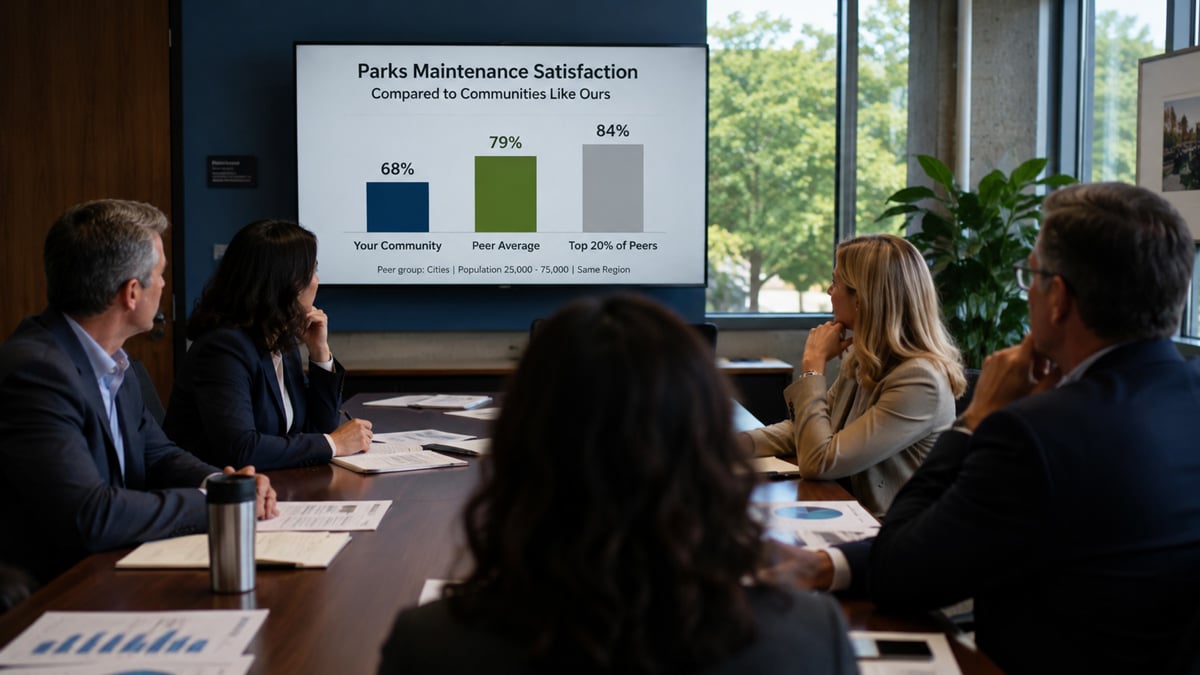
Every local government leader relies on data to justify decisions. Budget requests, strategic plans, capital investments, and service improvements all depend on demonstrating need. Yet even the strongest data can lose its influence when one simple question is asked during a council meeting or budget workshop: "Compared to what?" If the answer is a broad national average, the conversation often stalls. If the answer is "communities like ours," the discussion immediately becomes more meaningful because the comparison reflects the realities of governing a similar place.
That distinction is what separates reporting statistics from delivering decision intelligence. Numbers alone rarely persuade elected officials or residents. Decision-makers need confidence that the comparison reflects communities facing similar financial pressures, demographic trends, geographic characteristics, and service expectations. When data is grounded in relevant peer comparisons, it becomes far more difficult to dismiss and far more useful for guiding policy.
Why Average is Rarely Enough
National averages provide a useful starting point, but they are rarely the standard by which local governments should evaluate themselves. A rapidly growing suburban city has different challenges than a mature urban center. A rural county operates under different fiscal realities than a coastal tourist destination. Population size, regional economics, household demographics, and development patterns all influence how governments deliver services and how residents evaluate those services.
Without that context, benchmarking can create misleading conclusions. A city may appear to perform below average simply because it is being compared to communities with fundamentally different operating environments. Conversely, a community may appear to outperform national averages while still falling behind the jurisdictions that residents naturally compare themselves against. Good benchmarking acknowledges these differences instead of ignoring them.
The Right Comparison Changes the Conversation
Consider two different ways of presenting the same information. The first is straightforward: resident satisfaction with park maintenance is below the national average. While technically accurate, that statement leaves room for skepticism because it raises immediate questions about whether the comparison is appropriate.
Now consider a different statement. Resident satisfaction with park maintenance is lower than communities of similar population size, located in the same region, and serving residents with comparable demographic characteristics. The number has not changed, but its credibility has. Instead of debating whether the comparison is fair, leaders can focus on understanding what peer communities are doing differently and whether those practices can be adapted locally.
This is why peer benchmarking consistently produces more productive conversations than generalized comparisons. It shifts attention away from defending the data and toward solving the underlying problem.
Peer Benchmarking Creates Better Decisions, Not Better Rankings
One of the biggest misconceptions about benchmarking is that it exists to identify winners and losers. That perspective misunderstands its purpose. Effective benchmarking is not about outperforming neighboring communities or climbing a leaderboard. It is about understanding performance within an appropriate context and identifying opportunities to improve.
Communities often discover that they excel in areas they assumed were weaknesses, while uncovering challenges that had previously gone unnoticed. A department that consistently performs above peer communities despite limited resources may offer practices worth expanding across the organization. Likewise, a service that consistently lags behind comparable jurisdictions provides an early signal that additional investment, operational changes, or policy adjustments may be needed. In both cases, benchmarking becomes a tool for organizational learning rather than public comparison.
Better Context Builds Better Public Trust
Residents increasingly expect governments to explain not only what decisions are being made but also why those decisions are justified. Simply stating that a program requires additional funding or that a service needs improvement is no longer enough. People want evidence that public resources are being allocated based on measurable needs rather than assumptions or political pressure.
Peer benchmarking provides that evidence. When leaders explain that their community trails similar jurisdictions in sidewalk conditions, emergency response, housing affordability, or resident satisfaction, the discussion becomes rooted in facts rather than opinions. Likewise, when a community performs exceptionally well compared to its peers, those successes deserve recognition because they demonstrate responsible stewardship of public resources. Transparency becomes more credible when comparisons are meaningful rather than arbitrary.
Resident Feedback Makes Peer Benchmarking Even More Powerful
Operational data tells governments what happened. Representative resident feedback helps explain why it happened and whether those outcomes align with community expectations. Neither source of information is sufficient on its own because performance metrics and public perception often tell different parts of the same story.
A community may complete major park improvements while satisfaction remains flat because residents are more concerned about maintenance than expansion. Another city may have average response times for public safety while residents report exceptionally high confidence in emergency services because communication and professionalism shape public perception. Combining scientifically representative resident feedback with peer benchmarking gives leaders a more complete understanding of both performance and experience. That combination creates stronger strategic planning because decisions reflect measurable outcomes as well as the perspectives of the people those services are intended to serve.
The Strongest Leaders Welcome Comparison
Confident organizations do not avoid benchmarking because they fear unfavorable results. They embrace it because honest comparisons reveal where progress is occurring and where additional work is needed. The most respected local governments understand that continuous improvement begins with an accurate assessment of current performance.
This mindset also changes organizational culture. Departments become more interested in learning from high-performing peers than defending historical practices. Elected officials gain confidence that recommendations are supported by objective evidence. Staff members can prioritize initiatives based on demonstrated need instead of anecdotal concerns. Over time, benchmarking becomes less about measurement and more about building a culture of informed decision-making.
The Most Influential Phrase in Local Government
Every community has unique strengths, priorities, and challenges. That reality is precisely why meaningful comparisons matter. Generic averages provide background information, but peer benchmarking provides perspective. It allows leaders to evaluate performance against communities operating under similar conditions instead of against an abstract national standard.
The next time a council member asks whether a number is good or bad, the answer should not begin with a national average. It should begin with the communities that look most like your own. That single shift in perspective transforms data from an interesting statistic into credible evidence that can guide budgets, shape policy, build public trust, and support better decisions for years to come.
See How Your Community Really Compares
The most effective local government decisions begin with the right context. Knowing that resident satisfaction, service quality, or spending differs from a national average is informative. Understanding how your community compares to jurisdictions with similar populations, demographics, and operating environments is actionable.
Polco's Benchmark Surveys, including The National Community Survey® (The NCS®), provide statistically representative resident feedback paired with scientifically developed peer benchmarking. Instead of asking whether your community is above or below average, Polco helps you understand how you perform compared to communities that truly resemble your own. That deeper level of insight gives elected officials, executive leadership, and department directors the evidence they need to prioritize investments, strengthen strategic plans, communicate with residents, and make decisions with greater confidence.
Whether you are preparing a strategic plan, developing next year's budget, evaluating service performance, or measuring quality of life, meaningful comparisons can transform good data into better decisions.
Ready to see how your community compares? Learn how Polco's Benchmark Surveys provide the trusted peer insights that help local governments see clearly, act confidently, and build trust.


The Quiet Majority Problem: How to Hear from Residents Who Never Show Up to Meetings

Building Public Trust: What Top-Rated Communities Do Differently