
By Polco on May 26, 2026

For decades, local governments have chased the same question: Why do some communities consistently earn high resident satisfaction scores while others struggle to build trust and confidence?
After analyzing more than 30 years of benchmark survey data across hundreds of communities through Polco and The National Community Survey® (NCS), one pattern stands out clearly: The happiest communities are not always the wealthiest. They are not concentrated in one region. And they are not defined by population size. Instead, the communities with the strongest resident satisfaction scores tend to share a handful of remarkably consistent behaviors.
That matters because it means high resident satisfaction is achievable for almost any community willing to listen, adapt, and engage intentionally.
The Biggest Myth About Resident Satisfaction
Many leaders assume resident satisfaction is primarily driven by budget size. The logic seems reasonable. More funding should mean better parks, smoother roads, more amenities, and stronger services. But decades of benchmark data tell a more nuanced story.
Some smaller or mid-sized communities consistently outperform wealthier peers on resident trust, quality of life, safety perceptions, and confidence in local government. Meanwhile, some well-funded jurisdictions struggle to earn positive resident sentiment despite major investments.
Why? Because resident satisfaction is shaped less by how much a government spends and more by how residents experience their community every day. The communities with the highest scores focus relentlessly on livability, communication, transparency, and responsiveness.
High-Performing Communities Prioritize the Resident Experience
Top-performing communities understand something essential: Residents evaluate government through lived experience, not organizational charts. People remember whether they feel safe walking at night. Whether parks are clean. Whether traffic feels manageable. Whether local leaders communicate clearly during difficult decisions.
The strongest-performing communities consistently score well across core livability areas measured in The National Community Survey®, including:
- Safety
- Mobility
- Parks and recreation
- Inclusivity and engagement
- Community design
- Natural environment
- Health and wellness
Importantly, these categories are interconnected.
A resident who feels connected to their community often rates other aspects of community life more positively as well. Communities that create a sense of belonging frequently see stronger trust, engagement, and resilience over time.
They Treat Resident Feedback as Ongoing Infrastructure
The highest-performing communities do not view surveys as one-time exercises. They build continuous feedback loops into how they govern.
That means:
- Regular benchmark surveying
- Transparent reporting
- Follow-up engagement
- Longitudinal measurement over time
- Public communication around results and next steps
Communities that consistently improve resident satisfaction often measure progress year after year, using resident feedback as a strategic management tool rather than a public relations exercise.
This creates a powerful cycle:
- Residents provide feedback.
- Leaders communicate findings openly.
- Action follows.
- Residents see evidence their voice mattered.
- Trust increases.
- Participation grows stronger.
Over time, this process strengthens both civic confidence and decision-making quality.
Transparency Consistently Correlates with Higher Trust
One of the clearest patterns across benchmark data is the relationship between transparency and public confidence.
Communities with strong resident satisfaction scores tend to:
- Explain decisions clearly
- Share trade-offs openly
- Report progress publicly
- Involve residents early instead of late
Even difficult decisions receive stronger public support when residents feel informed and included. This is especially true around budgeting, development, infrastructure, and housing decisions.
Communities that proactively educate residents on trade-offs often see higher trust even during financially challenging periods. Transparency does not eliminate disagreement. But it dramatically improves legitimacy.
The Best Communities Balance Data with Human Insight
Data alone is not enough. High-performing communities combine quantitative benchmarks with qualitative understanding. They use statistically valid survey data to identify trends, then deepen understanding through conversations, meetings, focus groups, and ongoing engagement. The result is better context behind the numbers.
For example, communities using benchmark surveys alongside broader engagement strategies often uncover not only what residents prioritize, but why those priorities matter emotionally and practically in daily life.
This combination helps leaders move beyond assumptions and make decisions grounded in actual community experience.
They Invest in Communication Before Crisis Hits
Another consistent pattern among high-satisfaction communities is proactive communication.
Residents are more likely to trust local government when communication is:
- Frequent
- Clear
- Accessible
- Consistent across channels
Importantly, top communities communicate before problems escalate. They explain upcoming projects. They prepare residents for disruptions. They share timelines and expectations. They provide updates even when progress is imperfect. This reduces uncertainty and builds credibility over time.
Communities that maintain strong engagement channels also make participation easier for residents through digital platforms, surveys, project pages, and mobile-friendly updates.
Satisfaction Improves When Residents Feel Heard
One of the strongest drivers of positive resident sentiment is surprisingly simple:
People want to know their voice matters.
Communities that close the feedback loop consistently outperform those that collect input without visible follow-through. Residents become disengaged when participation feels performative. But when governments demonstrate how resident feedback shaped policy, investment, or priorities, satisfaction increases significantly.
This is why many leading communities now treat engagement as an ongoing operational strategy instead of a compliance requirement. The goal is not simply collecting opinions. The goal is building durable public trust.
What the Highest-Scoring Communities Ultimately Have in Common
After three decades of benchmark research, the strongest communities consistently share several defining traits:
- They listen continuously.
Not just during elections or crises. - They communicate transparently.
Especially when decisions are difficult. - They focus on livability.
Residents care deeply about everyday quality of life. - They measure progress consistently.
Longitudinal data creates clarity and accountability. - They act visibly on feedback.
Trust grows when residents see outcomes. - They treat residents like partners.
Not passive observers. - And perhaps most importantly:
They understand that resident satisfaction is not a vanity metric.
It is a leading indicator of community health, resilience, trust, and long-term success.
The Future of Community Satisfaction
Resident expectations are evolving. People increasingly expect governments to communicate more openly, engage more meaningfully, and respond more quickly to changing needs.
Communities that adapt to those expectations are far more likely to build lasting trust and stronger satisfaction over time. The encouraging news is that decades of data show these outcomes are achievable.
High-performing communities are not defined by geography or unlimited budgets. They are defined by intentional leadership, transparent engagement, and a genuine commitment to understanding the people they serve.
That is what the data continues to reveal, year after year.
See What Matters Most Before Small Problems Become Big Ones
The communities with the highest resident satisfaction scores do not rely on assumptions. They rely on trusted data, consistent engagement, and a clear understanding of what residents value most.
With Polco, local governments can measure resident satisfaction, benchmark against peer communities, uncover emerging priorities, and turn feedback into informed action. From The National Community Survey® (NCS) to ongoing engagement tools and analytics, Polco helps leaders build trust through transparency and evidence-based decision-making.
Because stronger communities start with listening.

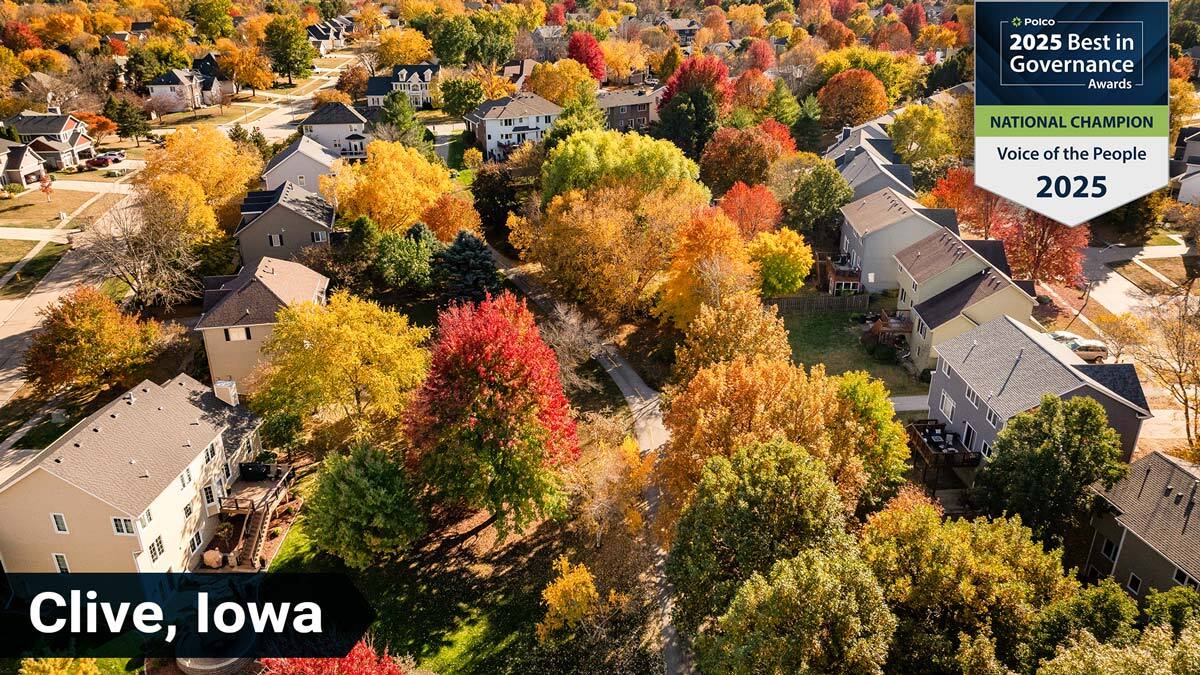
Clive, Iowa: A National Champion in Trustworthy Governance

Trust Across Generations: What 33 Million Americans Tell Us About Confidence in Local Government