

The Generational Trust Gap in Local Government
By Polco on November 17, 2026
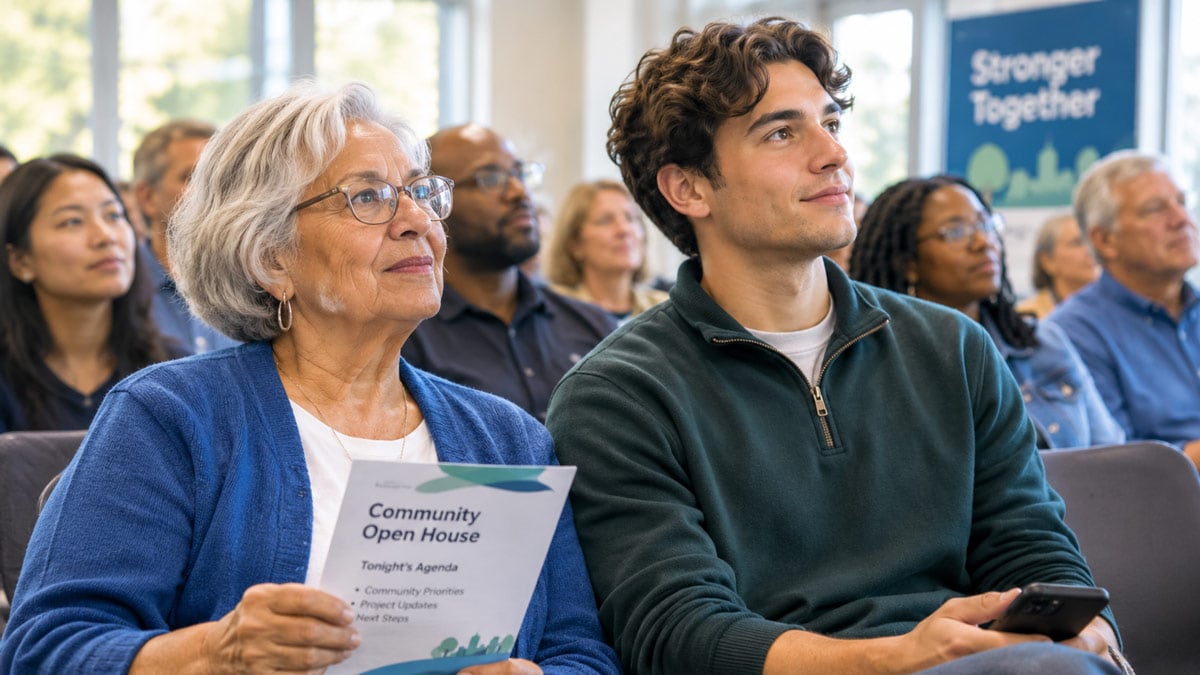
Ask a 68-year-old homeowner and a 26-year-old renter how well their city is run, and you will often get two different answers about the same city hall. Same streets, same council, same utility bill. Different verdict.
That split is the generational trust gap, and it shows up again and again in resident survey data. It matters because the residents who trust you least are the ones who will live with today's decisions the longest.
The gap is not a sign that younger residents have given up on local government. It is a sign that they judge it by different standards, meet it at different moments, and hear about it through different channels. Each of those can be addressed.
What the benchmark data shows
Trust in local government rises with age on nearly every measure, and the widest gap is about value for tax dollars. That is the pattern in Polco's National Community Survey (The NCS), which draws on more than 500 communities representing over 33 million residents.
|
Share rating it positively |
Gen Z |
Millennials |
Gen X |
Boomers |
Silent Gen. |
Gap (Silent Gen. minus Gen Z) |
|---|---|---|---|---|---|---|
|
Overall confidence in local government |
41% |
46% |
46% |
48% |
49% |
8 points |
|
Acts in the best interest of the community |
44% |
50% |
48% |
50% |
51% |
7 points |
|
Value of services for taxes paid |
37% |
44% |
46% |
50% |
54% |
17 points |
|
Customer service by employees |
59% |
63% |
67% |
72% |
75% |
16 points |
|
Overall quality of services |
61% |
66% |
67% |
69% |
75% |
14 points |
Generations by birth year: Gen Z 1999–2016, Millennials 1981–1998, Gen X 1965–1980, Boomers 1946–1964, Silent Generation 1928–1945.
Gen Z gives the lowest ratings on all five measures, and value for taxes is where the climb is steepest. It rises with every generation, from 37% among Gen Z to 54% among the Silent Generation.
Confidence in government as an institution moves much less. It spans only 8 points and barely shifts from Millennials (46%) to the Silent Generation (49%).
Service ratings show a gap too. Gen Z rates customer service 16 points below the Silent Generation, nearly as wide as the gap on value. Younger residents are tougher graders at the counter as well as on the tax bill.
Yet every generation rates services far above the institution. Gen Z rates service quality 20 points higher than its confidence in local government, and the Silent Generation's spread is 26 points. The foundation for trust is there. The work is connecting good service to the government that delivers it.
Why the gap exists
Three forces explain most of it: what residents expect from a digital experience, where they are in life, and where they get their information.
Digital expectations
A resident in their twenties has never known a world without order tracking, instant confirmations, and a status bar for everything. Their bank, pharmacy, and pizza place all tell them what is happening and when.
Then they report a broken streetlight and hear nothing. The repair may happen within the week, but the silence reads as indifference. For this cohort, a good outcome with no communication feels like a worse experience than a slow outcome with clear updates.
Older residents often judge the same interaction on whether the light got fixed. Younger residents judge it on whether they were kept in the loop. Neither standard is wrong, but only one of them is met by fixing the light.
Different life stages
Some of the gap has nothing to do with generation and everything to do with tenure. Older residents tend to have lived in a community longer, used more of its services, and seen long-term investments pay off. They watched the library get built.
Younger residents are more likely to be new in town and renting. They may never see a property tax bill, even though they pay it through rent. That helps explain why value for taxes is the widest gap in the data: it is hard to judge value on a cost you never see itemized.
Life stage also shapes which services a resident touches. A retiree may know the senior center, the parks, and the council member by name. A 27-year-old may know parking enforcement and the utility portal. Those are not equally warm introductions.
Media diets
Younger and older residents live in different information environments, and the Pew Research Center has measured how different.
|
Local government news habits (Pew, 2024) |
Ages 18–29 |
Ages 65+ |
|---|---|---|
|
Get local political news at least sometimes |
56% |
81% |
|
Get it often |
12% |
34% |
|
Get it from social media |
71% |
36% |
|
Get it from local news outlets |
53% |
75% |
The older resident reads about the budget vote in the local paper, often with context from a reporter who covers city hall. The younger resident is less likely to hear about it at all. When they do, it arrives as a clip or a comment thread, usually because something went wrong.
One source cuts across every age group. About 7 in 10 Americans of all ages hear local political news from friends, family, and neighbors. Word of mouth is the one channel the generations share.
There is also the era each generation grew up in. Gen Z came of age amid polarization and falling confidence in institutions of every kind. Skepticism is their starting point, and local government inherits it whether it earned it or not.
How to earn credibility with each cohort
No single message closes a gap with three causes. Each cohort needs proof in the form it finds convincing.
Gen Z and younger Millennials: show the receipt
This group is the hardest to convince and the most persuadable by evidence. Give them proof they can check themselves.
- Send status updates on every request. Confirm receipt, share an expected timeline, and report when the work is done. Treat the update as part of the service.
- Make the tax bill visible. A personalized taxpayer receipt shows a renter what their share buys: this much for fire, this much for parks. It speaks directly to the 17-point value gap.
- Publish outcomes, not activity. "Average pothole repair time fell from nine days to four" beats "crews stayed busy this spring."
- Go where they already are. Short video and plain-language posts on the platforms they use will reach more of them than a press release. A staff member explaining a project on camera puts a face on the institution.
- Own mistakes in public. A missed deadline explained honestly earns more credit with this cohort than a polished success story.
- Offer participation that fits in ten minutes. A mobile survey or an interactive budget exercise respects their time. Then report back on what changed because of their input.
Older Millennials and Gen X: respect their time
Residents in their late thirties to fifties are raising children, caring for parents, and covering a mortgage or rising rent. They are short on hours, not interest.
- Make every transaction work on a phone. Permits, payments, and program sign-ups should not require a trip to the counter during work hours.
- Offer asynchronous input. A 7 p.m. Tuesday meeting excludes most working parents. An online option open for two weeks does not.
- Connect budgets to daily life. Frame decisions around what this cohort uses most: schools, roads, youth programs, and public safety.
- Show trade-offs honestly. This group makes household budget choices daily. Let them see what a decision costs and what it displaces, and they will respect the answer even when they disagree.
- Recruit them. A direct invitation to a board or commission, with a clear time commitment, brings in mid-career residents who assumed those seats were not for them.
Boomers and the Silent Generation: protect what you have
Older residents give the highest ratings, but that trust is not guaranteed. It rests on relationships and channels that many governments are quietly retiring.
- Keep a human reachable. As services move online, keep the phone line and the front counter. A digital-only switch can feel like abandonment to a loyal resident.
- Keep print and local media in the mix. Three-quarters of residents 65 and older get local political news from local outlets. Mailers, utility bill inserts, and the local paper still work.
- Show up in person. Open houses, senior center visits, and neighborhood meetings carry weight with residents who value face-to-face contact.
- Offer help with new tools. A short walkthrough at the library turns a frustrating portal into a convenience.
- Ask for their help. Long-tenured residents hold institutional memory and neighborhood credibility. Since 7 in 10 residents of every age hear local news from people they know, these residents can be your best messengers to younger neighbors.
One rule for every generation
Close the loop. When you ask residents for input, tell them what you heard and what you did about it. A 24-year-old wants that in a post and a 74-year-old may want it in a newsletter, but both are asking the same question: did it matter that I spoke up?
Start by measuring your own gap
National benchmarks show the pattern, but your community has its own version of it. A college town, a retirement destination, and a fast-growing suburb will each show a different gap, on different issues.
You can only close a gap you can see. A statistically valid resident survey with results broken out by age shows where confidence drops, which services each cohort values, and whether your efforts are working over time.
Younger residents already rate your services well above your institution. The work ahead is connecting those good experiences to the institution that delivers them, in a form each generation can recognize.
Want to see how each generation rates your community?
Polco's National Community Survey (The NCS) measures resident trust and satisfaction by age group and benchmarks your results against more than 500 communities nationwide.
Popular posts
Sign-up for Updates
You May Also Like
These Related Stories
Clive, Iowa: A National Champion in Trustworthy Governance

Why Trust Is the New Infrastructure for Local Government
